I-601 vs I-601A Waiver: Key Differences, Eligibility & Approval Guide (2026)

i-601 vs i-601a waiver

You know, the I-601 waiver in immigration? It’s one of those game-changers that can totally turn a case around. Picture this: someone’s hit with inadmissibility to the U.S.—maybe some past slip-up. This waiver? It’s like knocking on the door of immigration folks, saying, “Hey, please forgive this and let us keep going.”

What immigration i 601 waiver really means

immigration i 601 waiver is used when immigration law says someone cannot enter or stay in the U.S. due to past problems. Instead of automatically refusing the case, the government allows a second chance through this waiver.

It usually comes into play when:

  • Someone stayed in the U.S. without legal permission
  • There was a mistake or misrepresentation in a visa case
  • A previous immigration violation exists
  • A deportation or removal order is part of the record

When approved, the immigration i 601 waiver removes that barrier and allows the immigration process to continue.

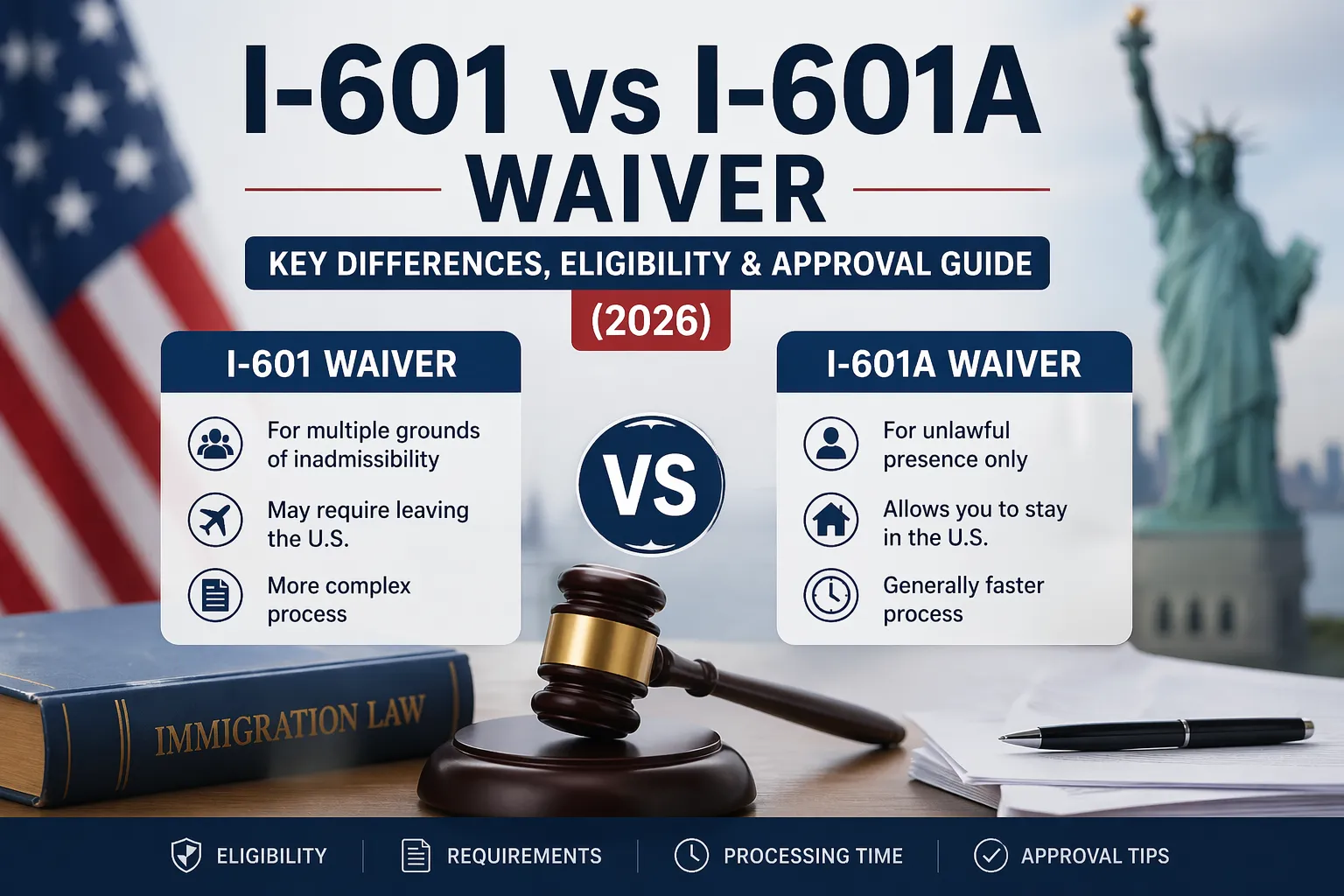
I-601 vs I-601A explained in simple way

This is where most confusion happens, so it’s better to keep it very clear.

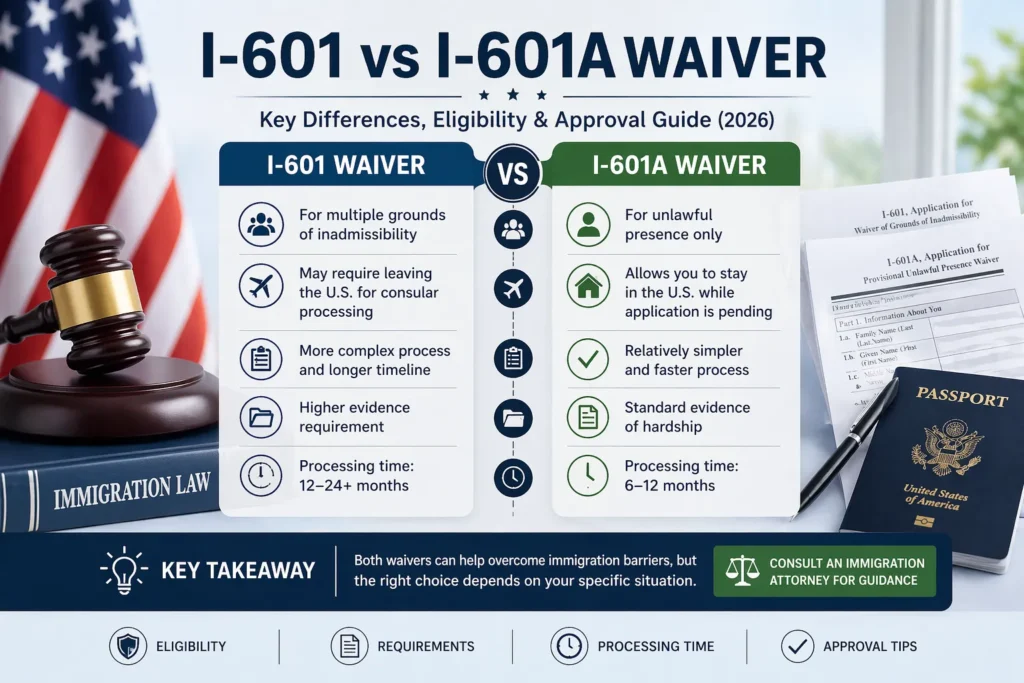
The I-601 waiver is the broader one. The I-601A is more limited.

  • I-601 covers multiple immigration problems
  • I-601A only deals with unlawful presence
  • I-601 may require leaving the U.S.
  • I-601A allows staying inside the U.S. while waiting

So when people talk about immigration i 601 waiver, they are usually referring to the more complete and serious version of the process.

Who actually qualifies for immigration i-601 waiver

Not everyone can apply. It is not automatic, and eligibility is checked carefully.

Usually, approval depends on:

  • Having a close family member in the U.S. like a spouse, parent, or child
  • Showing that this family member will suffer serious hardship
  • Providing real proof of emotional, financial, or medical impact
  • Clearly explaining immigration history without confusion

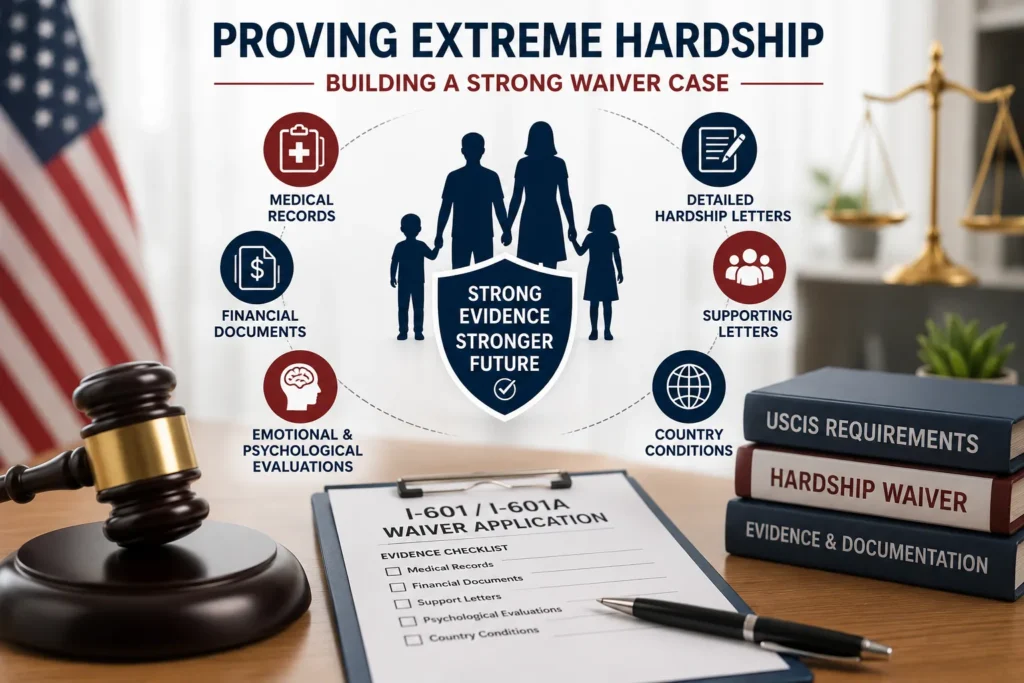
The whole immigration i 601 waiver case is built around one main idea: proving hardship in a very strong way.

What “extreme hardship” really means

This is the heart of the case, and it is where everything is decided.

Extreme hardship is not just normal difficulty. It means real serious impact like:

  • A spouse struggling financially without support
  • A parent dealing with medical issues without care
  • Children facing emotional or educational disruption
  • Family separation causing long-term psychological stress

Immigration officers focus heavily on this part of the immigration i 601 waiver because it decides approval or denial.

Why many cases get rejected

A lot of people qualify but still get denied. That usually happens because the case is not strong enough.

Common problems include:

  • Weak explanation of hardship
  • Missing supporting documents
  • No proper financial or medical proof
  • Incomplete or unclear application
  • Story not consistent across documents

A strong immigration i 601 waiver always feels complete, organized, and clearly supported with evidence.

Filing Fee and Cost Reality

There is always a government fee set by USCIS, and it can change over time.

Typical cost breakdown:

  • USCIS filing fee for Form I-601
  • Optional attorney fee if legal help is used
  • Translation of documents if needed
  • Medical reports or expert evaluations in complex cases

Even though cost matters, what really matters in immigration i 601 waiver is the strength of the case, not just how much is paid.

How long the Process Usually Takes

Processing time is not fixed because every case is different.

General timeline looks like:

  • Simple cases: around 6 to 12 months
  • More complex cases: 12 to 24 months
  • Cases with extra requests: even longer

Each immigration i 601 waiver moves based on how complete and clear the submission is.

difference between i-601 vs i-601a waiver

Step-by-Step Process Explained Simply

Step 1 – Checking Eligibility

First thing is confirming if inadmissibility exists and whether there is a qualifying relative.

Step 2 – Collecting Strong Evidence

This includes financial records, medical documents, and anything showing hardship clearly.

Step 3 – Filling the Form

Form I-601 must be filled carefully, because small mistakes can delay everything.

Step 4 – Submitting Application

The full package is sent to USCIS with required fee and documents.

Step 5 – Waiting for Decision

USCIS reviews everything and may ask for more proof before making a final decision.

A properly prepared immigration i 601 waiver always has a stronger chance because everything is clear and complete.

Approval Rate Understanding

There is no fixed approval rate that guarantees success.

What really matters is:

  • Strength of hardship evidence
  • Clarity of documents
  • Consistency in explanation
  • Overall case presentation

A weak immigration i 601 waiver can fail even if eligibility exists, while a strong one can succeed even in complex situations.

I-601A updates

Recent trends show:

  • More careful document checking
  • Focus on accurate hardship claims
  • Gradual improvement in processing speed

These updates also influence how immigration i 601 waiver cases are reviewed because both processes are connected.

Immigration Lawyer Role in Real Cases

A immigration lawyer is not just for filing papers. They help shape the entire case.

They usually:

  • Turn personal situations into strong legal arguments
  • Avoid small mistakes that can cause rejection
  • Organize documents properly
  • Respond to USCIS requests correctly

Many people use legal help for immigration waiver because the process is detailed and one small error can create delays.

Simple Summary of Key Differences

  • I-601 is broader and more complex
  • I-601A is only for unlawful presence
  • One may require leaving the U.S.
  • Evidence requirements are different
  • Risk level is not the same

Understanding this clearly helps avoid mistakes in immigration i 601 waiver cases.

Final important points before applying

  • Strong evidence is everything
  • Hardship must feel real and serious
  • Forms must be complete and accurate
  • Processing takes patience
  • Every case is reviewed separately

A successful immigration i 601 waiver is not about luck, it is about preparation and clarity.

Frequently Asked Questions

How long does immigration i 601 waiver take?

It usually takes between 6 and 24 months depending on case complexity and whether USCIS asks for more documents during review.

What is the main reason for denial?

Most denials happen because applicants fail to prove extreme hardship with strong and detailed supporting evidence.

Is immigration i 601 waiver guaranteed?

No approval is not guaranteed. Each case is reviewed separately based on evidence strength and overall presentation.

What is the difference between I-601 and I-601A?

I-601 covers multiple immigration issues and may require leaving the U.S., while I-601A only covers unlawful presence and allows staying in the U.S.

What is extreme hardship?

It means serious emotional, financial, or medical difficulty that a U.S. family member would face if separation happens.

Can someone apply without a lawyer?

Yes it is possible, but many people prefer legal help because small mistakes can affect the outcome of the case.

What happens after approval?

After approval, the immigration process continues and the applicant can move forward with visa or green card processing.

Does approval solve everything permanently?

No, it only removes a specific immigration barrier in that case. Future applications are still reviewed under immigration law.

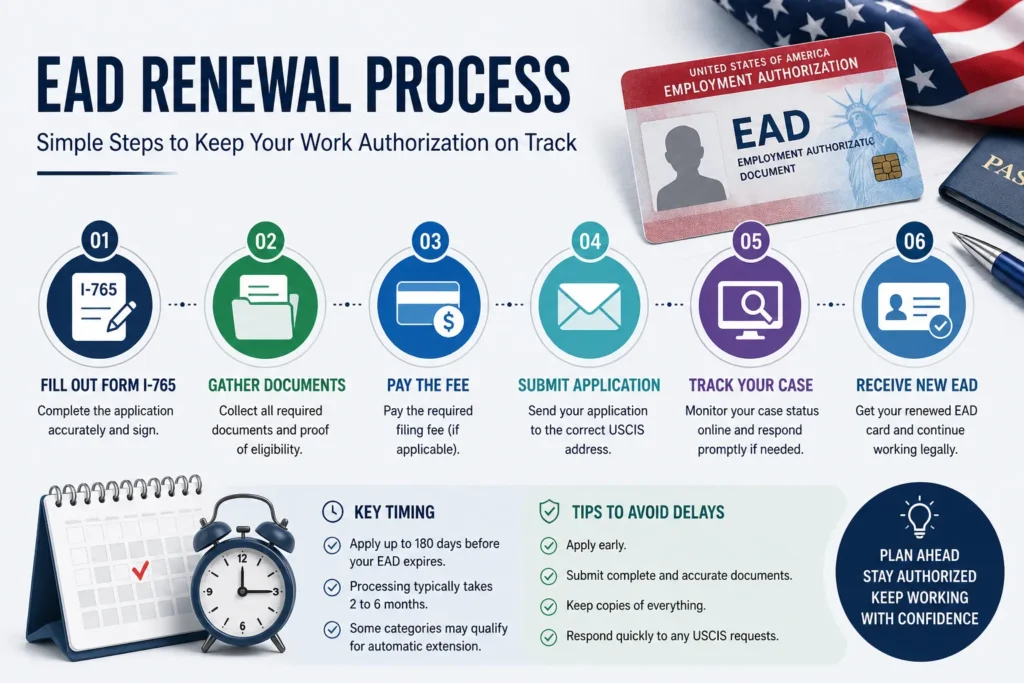
Public Charge Rule Explained: How It Affects Your Green Card Application

public charge immigration rule

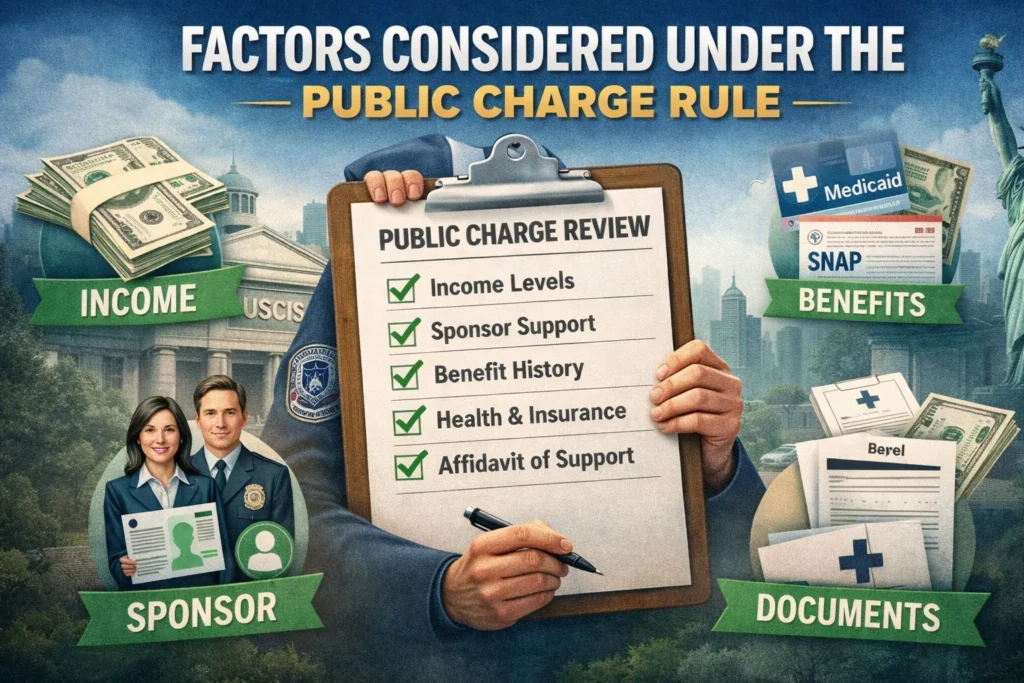
A public change rule is one of the most important checks used in immigration cases, especially when someone applies for a green card application. The public change rule focuses on whether an applicant may depend on government assistance in the future instead of being financially self-supported. The public change rule plays a direct role in deciding how immigration officers evaluate long-term financial responsibility.

What the Public Charge Rule Means in Simple Terms

The public change rule is basically a screening method used during immigration processing to judge financial independence. It is used to understand whether a person is likely to depend on public benefits like housing support or income assistance.

The public change rule does not only look at current income. It looks at long-term ability to support oneself or be supported by a sponsor. This is why documents like employment proof, tax history, and financial statements become very important.

In real cases, the public change rule is applied as part of green card evaluation, especially for family-based immigration applications.

  • Income stability is reviewed
  • Employment history is checked
  • Sponsor financial strength is analyzed
  • Health and dependents may be considered

The public change rule helps immigration officers decide whether approval is safe from a financial responsibility point of view.

How Public Charge Rule Impacts Immigration Cases

The public change rule has a direct influence on immigration decisions because it connects financial stability with eligibility. If there is doubt about self-sufficiency, the application may face delays or additional scrutiny.

Under the public change rule, immigration officers look at the overall profile instead of one single factor. A person with low income but strong sponsorship may still qualify, depending on total evaluation.

The public change rule is often discussed because it affects many applicants in family-based green card cases where financial sponsorship is required.

Key factors reviewed include:

  • Income compared to federal poverty guidelines
  • Strength of sponsor affidavit
  • Job skills and education level
  • Health conditions and insurance coverage
  • Past usage of public benefits

The public change rule does not automatically reject applicants but increases scrutiny when financial risk appears.

Trump Era Changes and Policy Adjustments

The public change rule became stricter during the Trump administration, when more detailed financial checks were introduced. These changes expanded how immigration officers evaluated dependency risk.

Under those trump public change rule changes, more benefits and financial indicators were included in the assessment process. This made the process more complex for applicants.

The public change rule during that time placed heavier weight on income levels and benefit usage history. Applicants needed stronger documentation to prove independence.

Even though some of these changes were later revised, the public change rule still reflects the idea of financial self-sufficiency as a core requirement.

Important shifts included:

  • Broader definition of public benefits
  • Stronger income requirements
  • Deeper review of sponsor financial capacity
  • Increased documentation checks

The public change rule continues to evolve but still keeps financial responsibility at its center.

Does It Affect Green Card Approval

The public change rule plays a major role in green card processing decisions. It is not the only factor, but it can influence approval outcomes significantly.

When applying for a green card, the public change rule helps determine whether an applicant may become dependent on public assistance in the future. If that risk is considered high, the case may require additional evidence.

The public change rule is especially important in family-based petitions where financial sponsorship is required. A weak sponsor or unclear income history can raise concerns.

Situations where the public change rule becomes more important:

  • Low or unstable income
  • Lack of sponsor support
  • Limited work history
  • No clear financial documentation
  • Dependents with high financial needs

The public change rule evaluates the entire financial picture before making a decision.

public charge rule latest updates

How the Rule is Applied in Real Immigration Reviews

The public change rule is applied through a structured review process. Immigration officers do not rely on guesswork but use documentation and eligibility criteria.

Each application under the public change rule is reviewed individually. This means two applicants in similar situations may still receive different outcomes depending on overall evidence.

The public change rule typically examines:

  • Income sources and consistency
  • Sponsor affidavit strength
  • Age and employability
  • Education and skill level
  • Health insurance and medical needs

The public change rule is designed to identify long-term financial stability rather than short-term conditions.

Latest Updates in Public Charge Rule Policies

The public change rule continues to change based on new immigration guidance and policy updates. Recent updates focus more on simplified evaluation instead of overly complex scoring systems.

The public change rule latest updates show a shift toward clearer interpretation of financial independence without overly broad restrictions.

Applicants are encouraged to stay updated with official immigration guidance because the public change rule can be adjusted based on administrative changes.

Current direction includes:

  • Simplified financial evaluation criteria
  • Reduced focus on benefit scoring complexity
  • More emphasis on core documentation
  • Case-by-case review improvement

The public change rule still remains an important part of green card and visa processing.

Conclusion:

The public change rule remains a central part of immigration evaluation, especially in green card applications where financial stability is essential. It is designed to ensure applicants can support themselves or have reliable sponsorship.

Understanding how the public change rule works helps applicants prepare better documentation and reduce delays. It is not about rejection by default but about assessing financial responsibility clearly.

The public change rule continues to evolve, but its main purpose stays the same: evaluating long-term self-sufficiency in immigration decisions.

Frequently Asked Questions

What does the public charge rule actually check during immigration review?

The public charge rule checks whether an immigration applicant is likely to depend on government assistance in the future by reviewing income, sponsorship, employment history, and overall financial stability to ensure long term independence.

Can the public charge rule stop green card approval completely?

The public charge rule can impact green card approval if strong evidence shows high dependency risk, but it does not automatically deny applications because multiple financial and personal factors are considered together.

Why is the public charge rule important for immigration cases?

The public charge rule is important because it helps immigration officers evaluate whether an applicant will be financially self-sufficient or require public support, which is a key factor in long term residency decisions.

What documents are most important under public charge rule review?

Under public charge rule review, income proof, tax returns, employment letters, sponsor affidavit of support, and financial statements are critical because they demonstrate stability and ability to avoid dependency.

Who is most affected by the public charge rule in immigration?

Family based green card applicants are most affected by the public charge rule because they often rely on sponsors, making financial documentation and sponsor strength very important in their evaluation process.

Did Trump changes make the public charge rule stricter?

Trump era changes made the public charge rule stricter by expanding benefit review and increasing income scrutiny, which led to more detailed financial assessments during immigration application processing.

Is using public benefits always a problem under public charge rule?

Using public benefits is not always a problem under the public charge rule because immigration officers look at overall long term dependency risk rather than isolated or short term benefit usage.

What income level is considered safe under public charge rule?

There is no fixed safe income level under public charge rule, but earning above poverty guidelines with consistent employment and strong sponsor support generally improves approval chances significantly.

Can a strong sponsor help under public charge rule?

A strong sponsor can greatly help under public charge rule because financial responsibility can shift partly to the sponsor, improving overall application strength and reducing dependency concerns.

How can applicants reduce risk under public charge rule?

Applicants can reduce risk under public charge rule by maintaining stable income, submitting complete financial documents, securing strong sponsor support, and showing consistent employment history over time.

DACA Updates 2026: Who Qualifies & What’s Changing?

immigration lawyer for DACA

DACA requirements are what everything comes down to right now. Not headlines, not opinions, not assumptions. Just the actual requirements and how they are being applied today. In 2026, things feel uncertain, but they are not completely unclear. There is still a system in place, still a process being followed, and still a way to stay protected if everything is handled carefully.

People are not just searching for information anymore. They are trying to figure out where they stand. Whether they are still safe. Whether they should renew. Whether anything has changed that could affect them.

That is exactly what needs to be explained properly.

What DACA Looks Like Right Now

DACA is still running, but not with the same stability it once had. Courts are still involved. Decisions are still being challenged. That is why daca news keeps changing and why updates sometimes feel confusing.

But here is the simple reality.

Renewals are still going through. People are still receiving approvals. Work permits are still being issued.

New applications are where things get complicated. They are not fully open in the way people expect. So for most individuals, the focus is not on applying for the first time. It is on maintaining what already exists.

And maintaining that comes back to one thing again: DACA requirements.

Who Qualifies for DACA Today

This question is not going away anytime soon: who qualifies for DACA?

The criteria itself has not been rewritten. It is still based on the original structure.

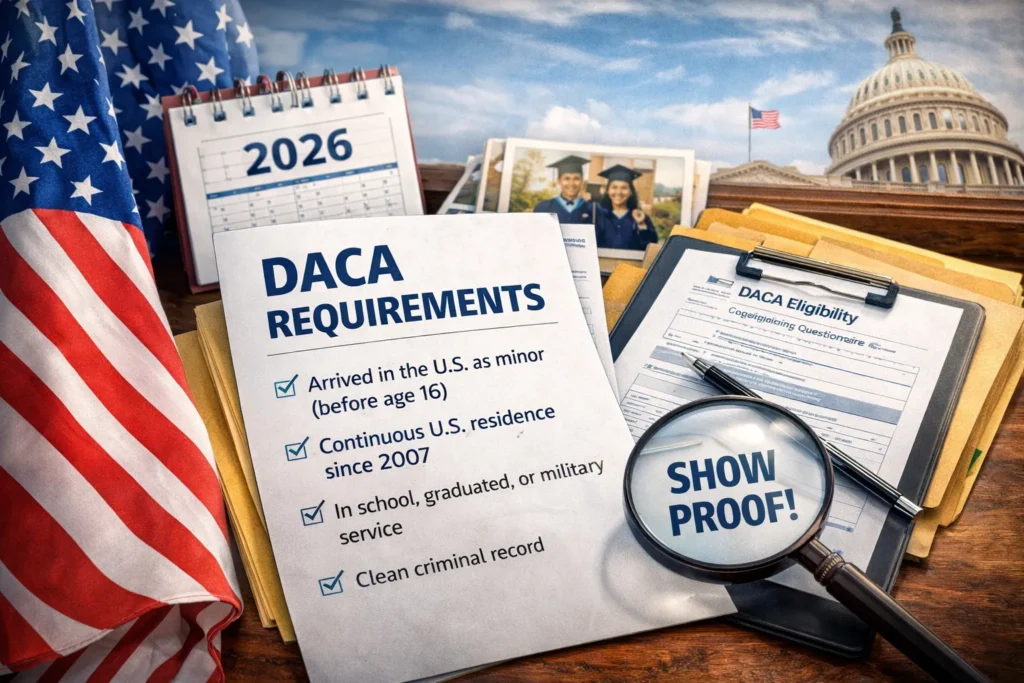
The basic conditions still include:

  • Entry into the US before age 16
  • Continuous residence since 2007
  • Being under 31 as of June 2012
  • No legal immigration status at that time
  • Being in school, graduated, or military service
  • No serious criminal record

On paper, these look straightforward. But in reality, every part of these DACA requirements has to be proven clearly. Not assumed. Not estimated. Proven.

That is where many people struggle.

Understanding DACA Requirements Beyond the Surface

Reading DACA requirements is one thing. Actually meeting them in a way that gets approved is something else.

It is not just about saying continuous residence. It is about showing it.

It is not just about saying no criminal history. It is about having a clean, verifiable record.

It is not just about saying eligible. It is about backing every claim with documents.

What this really means:

  • Every year should be supported with records
  • Every document should match timelines
  • Every gap should be explained

This is where attention matters. Because even if someone technically meets DACA requirements, weak documentation can still cause problems.

DACA Application Requirements in Real Terms

The phrase DACA application requirements sounds formal, but it simply refers to what needs to be submitted.

And this is where things get practical.

What is usually required:

  • Proof of identity
  • School or education records
  • Evidence of arriving before age 16
  • Documents showing continuous stay
  • Background checks

Nothing here is complicated on its own. But together, they need to tell one clear story that matches the DACA requirements.

If the story does not connect, the application slows down or gets questioned.

DACA requirements

The DACA Renewal Process Explained Clearly

The DACA renewal process is where most attention is right now.

This is not something to delay or guess.

The process usually looks like this:

  • Apply 120 to 150 days before expiration
  • Review all previous information carefully
  • Update anything that has changed
  • Submit documents and fees
  • Wait for processing and approval

It sounds routine, but timing is critical.

If renewal is submitted too late and status expires, protection can be lost. Even if all DACA requirements are met, timing mistakes create unnecessary risk.

What Is Actually Changing in 2026

There is a lot of noise around changes, but not everything is shifting at once.

Here is what is actually happening:

  • Courts are still reviewing DACA
  • Renewals are still active
  • First-time applications are still limited
  • Policy direction depends on future decisions

This is why following latest DACA news matters, not for stress, but for staying informed.

And through all these changes, the base standard has not moved. It is still the same DACA requirements guiding everything.

Immigration Reform and What Could Happen Next

There is ongoing discussion around immigration reform DACA, but nothing final has been passed yet.

The conversations include:

  • Creating a path to permanent residency
  • Expanding eligibility
  • Turning DACA into a permanent law

If that happens, it changes everything. But until then, the current system continues to rely on existing DACA requirements.

When Legal Help Becomes Important

Some situations are simple. Others are not.

That is where an immigration lawyer for DACA becomes important.

It makes sense to get help when:

  • There is any criminal record
  • Documents are missing or unclear
  • A previous application was denied
  • There are gaps in residence history

Legal guidance helps make sure DACA requirements are not just met, but properly presented.

Mistakes That Keep Happening

A lot of issues are avoidable, but they still happen often.

The most common ones include:

  • Waiting too long to renew
  • Sending incomplete documents
  • Not following updated daca news
  • Misunderstanding DACA requirements
  • Ignoring small inconsistencies

These mistakes seem small, but they can delay or even block approval.

Quick Reality Check Table

AreaWhat It Looks Like Now
New ApplicationsRestricted
RenewalsOngoing
Work AuthorizationActive with renewal
Legal StatusUnder review
Key FocusMeeting DACA requirements

Why Everything Still Comes Back to DACA Requirements

At the end of the day, everything connects back to DACA requirements.

They decide:

  • Who stays protected
  • Who gets approved for renewal
  • Who can work legally
  • Who faces uncertainty

Even with legal challenges and policy discussions, these requirements are still the core of the system.

Understanding them clearly, preparing documents properly, and staying updated is what makes the difference.

Frequently Asked Questions

What are the DACA requirements in 2026?

They include arriving in the US super early, staying here without big gaps, either being in school or working, and yeah, keeping that criminal record spotless. But let me tell you—approvals come down to nailing your documentation and watching those current legal decisions like a hawk.

Who qualifies for DACA right now?

Well, if you’re hitting every single eligibility condition, you might be in. Thing is, new applications are limited big time, and approvals are mostly locked in on renewals under the rules we already have.

Is the DACA renewal process still available?

In 2026, DACA renewals are totally active. It’s really the main lifeline keeping folks’ protection and work authorization alive and kicking.

Can someone apply for DACA for the first time?

Those court rulings have new apps restricted tight. Even if you meet all the DACA requirements, first-time approvals? They’re uncertain as heck right now.

What are the DACA application requirements?

Alright, breaking down the DACA application requirements: think proof of your identity, school records to show your path, and solid evidence of where you’ve resided—all gotta match up perfectly with the eligibility criteria, no ifs or buts.

Is DACA ending soon?

Nah, no confirmed end, but check the latest DACA news—it’s all ongoing legal reviews that keep the future feeling shaky and uncertain, doesn’t it?

Do I need an immigration lawyer for DACA?

It’s super helpful in those messy cases, like when documentation’s iffy or legal stuff could derail your approval chances.

What happens if DACA expires before renewal?

Protection and work authorization vanish, even if you meet every DACA requirement. That’s why I always say, renew early and stay safe.

How does immigration reform impact DACA?

Down the line, reform pushes might deliver permanent solutions, but right now? The program’s holding steady under temporary rules, hanging in there.

Is renewing DACA still worth it?

Totally yes—meet those DACA requirements, renew on time, and you hold onto your protection and work authorization, uncertainty be damned.

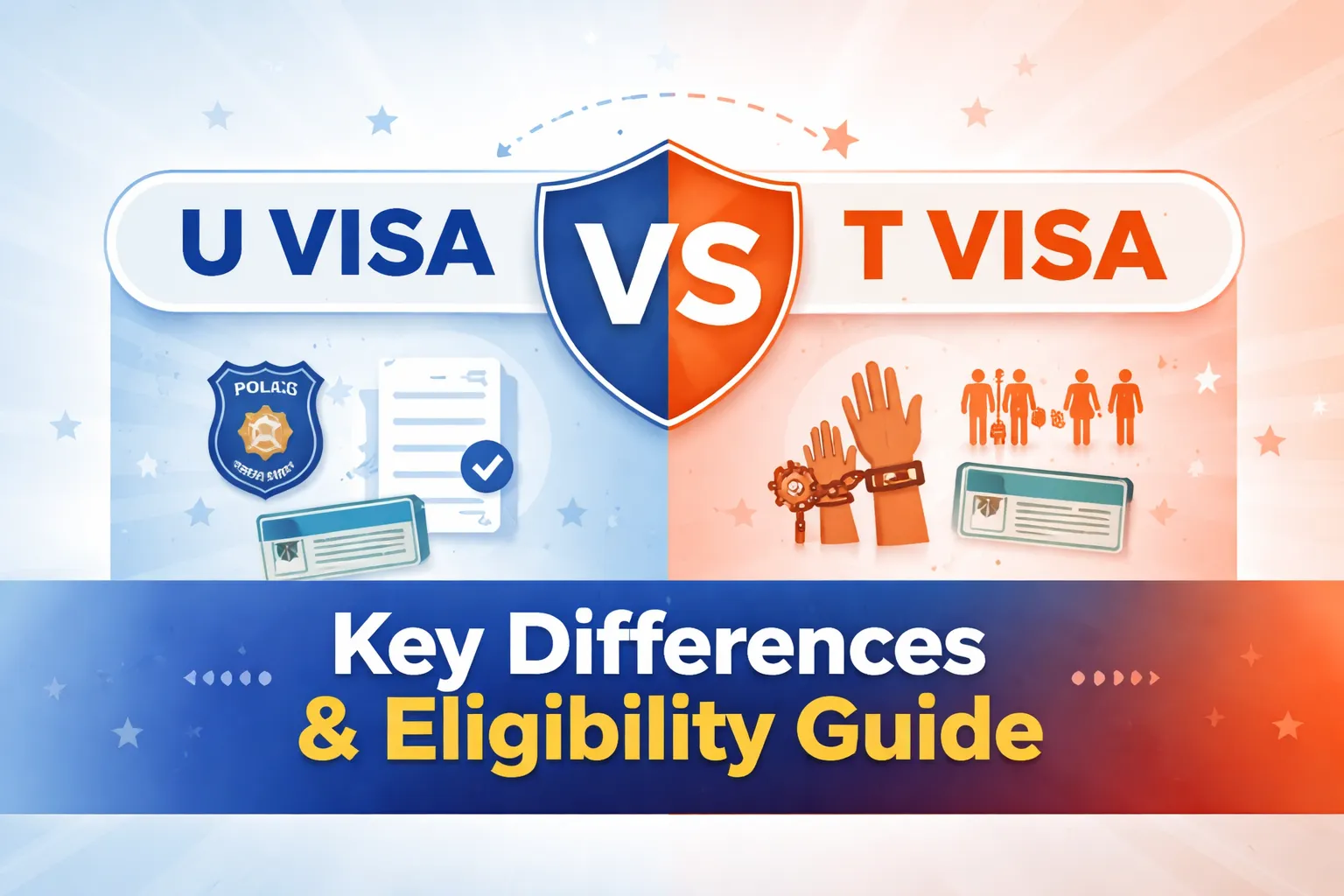
U Visa vs T Visa: Key Differences, Eligibility & Which One to Choose

T visa vs U visa is something people usually search when they are confused about immigration protection after something serious has happened. It sounds technical, but in reality it is very simple once explained in plain words. t visa vs u visa is basically about two different ways the US protects victims, but both are for very different situations.

It is important because choosing the wrong path or misunderstanding it can slow down a case or create rejection risks. Both options can give legal stay, work permission, and long-term residency possibilities, but the rules are not the same.

T visa vs U visa also comes up a lot because people think they are interchangeable, but they are not. One is for trafficking situations, the other is for crime victims who help law enforcement.

Simple meaning of both visas

What each one is for

  • T Visa = trafficking victims protection
  • U Visa = crime victims protection

That is the easiest way to understand t visa vs u visa. One is for exploitation and trafficking situations, and the other is for serious crimes like assault or domestic violence.

In t visa vs u visa, the difference starts from the type of harm, not just paperwork.

Eligibility made very simple

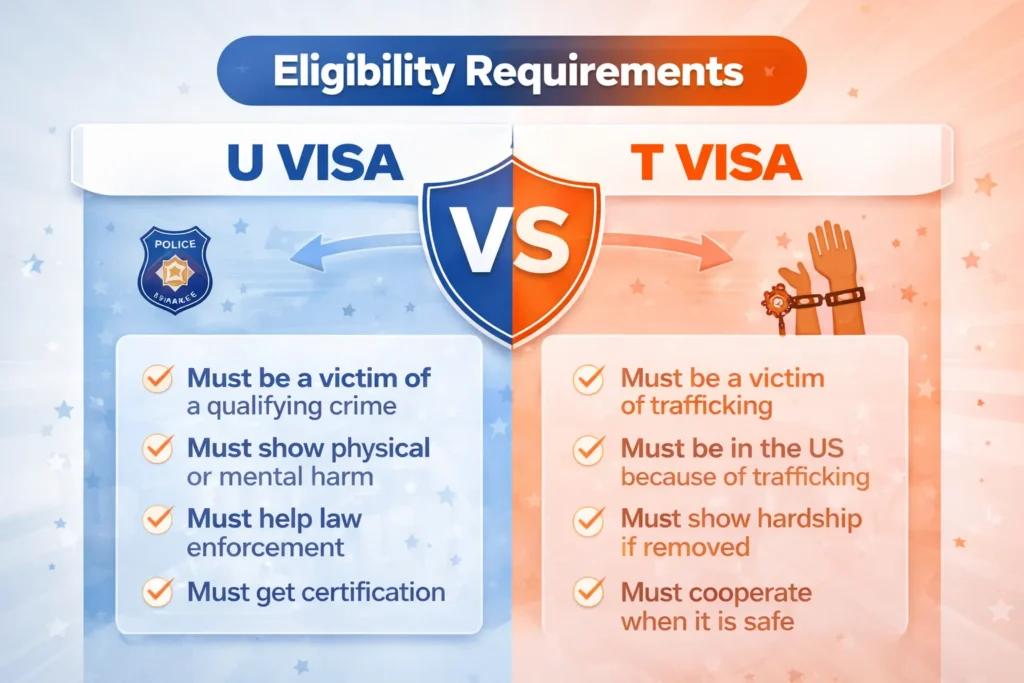
T Visa basic requirements

  • Must be a visa options for trafficking victims
  • Must be in the US because of trafficking
  • Must show hardship if removed
  • Must cooperate when it is safe

When looking at t visa vs u visa, the T visa is more focused on safety and recovery rather than legal cooperation.

U Visa requirements

  • Must be a victim of a qualifying crime
  • Must show physical or mental harm
  • Must help law enforcement
  • Must get certification

In t visa vs u visa, the U visa is more strict about police involvement and certification.

Big difference between U visa and T visa in real life

Law enforcement role

  • U Visa needs strong police involvement
  • T Visa USA only requires cooperation if safe

This is a major point in t visa vs u visa because it changes how the case moves forward.

Focus of each visa

  • T Visa focuses on protection and survival
  • U Visa focuses on justice and investigation

So in t visa vs u visa, one is more humanitarian and the other is more law-enforcement based.

U Visa vs T Visa: Key Differences & Eligibility Guide

Processing time difference

U Visa timing

  • Usually takes years
  • Annual cap slows everything
  • Long waiting list

T Visa timing

  • Often faster than U Visa
  • No strict yearly cap
  • Depends on evidence

In t visa vs u visa, time becomes a major deciding factor for most people.

Benefits of both visas

What both give

Even though t visa vs u visa is different in process, both lead to similar long-term benefits.

Real situation examples

T Visa situation

Someone controlled, forced, or exploited in a trafficking situation and unable to leave safely.

U Visa situation

Someone assaulted or abused and willing to help police investigate the case.

This is where t visa vs u visa becomes very clear in real life situations.

Common confusion explained simply

Why people mix them up

  • Both are for victims
  • Both give legal protection
  • Both lead to residency

But in t visa vs u visa, the purpose behind each one is different, which is the main point.

Simple decision guide

Ask these questions

  • Was there trafficking or exploitation
  • Was there a crime with police involvement
  • Is cooperation with law enforcement possible
  • What evidence is available

In t visa vs u visa, answers to these questions decide everything.

Why legal help matters

What immigration lawyer for U visa help with

  • Building strong evidence
  • Getting correct forms
  • Avoiding mistakes
  • Handling delays

In t visa vs u visa, small errors can change outcomes, so proper guidance matters a lot.

Conclusion:

At the end, t visa vs u visa is not about which one is better. It is about which one fits the situation. T visa is for trafficking protection. U visa is for crime victims helping law enforcement.

Understanding t visa vs u visa clearly makes the whole process less confusing and helps avoid wrong applications. Both exist to protect people, but both follow different rules and paths.

Frequently Asked Questions

What’s a T visa vs. U visa in simple words?

T visa and U visa are two immigration relief for crime victims usa. T visa are for people who survived trafficking, and U visa’s for crime victims helping out law enforcement. Both give you protection and a legal stay if you qualify.

Who should go for a T visa?

If you’ve dealt with trafficking, coercion, or forced work and ended up in the US because of it, T visa’s your pick. It offers protection plus support to help you recover.

Who should go for a U visa?

U visa fits if you’re a victim of big crimes like assault, domestic violence, kidnapping, or abuse, and you’re up for cooperating with police on their investigation—once you get that certification.

What’s the biggest difference between T visa and U visa?

It boils down to what they’re for. T visa protects trafficking survivors, while U visa backs crime victims who team up with law enforcement for investigations or trials.

Do T visa and U visa need police involvement?

Yeah, but not the same way. U visa requires a certification from law enforcement. T visa just asks for cooperation if it’s safe and reasonable for you.

Which one’s faster, T visa or U visa?

T visa requirements tends to process quicker—no annual caps holding it back. U visa? It drags on for years with all the demand and limited spots each year.

Can both T visa and U visa lead to a green card?

Sure can. Meet the rules, keep your status legal, and stick around the U visa processing time—both paths open the door to permanent residency.

What evidence do you need for T visa vs. U visa?

Stuff like your own statement, police reports, medical records. For U visa, toss in that law enforcement certification proving you helped with the case.

Does work permission come with T visa or U visa?

Yep, both hand out work authorization to approved folks. You can work legally in the US and stay in good standing.

How do you pick between T visa and U visa?

Look at your story. Visa options for trafficking victims comes all the way. Other crime where you can help cops? U visa’s the match.

Deportation Defense Strategies: How to Fight Removal Successfully

deportation defense strategies

Deportation defense strategies start with understanding the fight ahead. Facing removal proceedings feels overwhelming, but proven steps exist to push back effectively. These deportation defense strategies give real options for staying in the U.S.

Why Deportation Defense Strategies Matter

Deportation defense strategies focus on challenging ICE’s case right away. They target weaknesses in the charges or build paths to relief. People often win by combining multiple approaches tailored to their situation.

Strong deportation defense strategies protect families and long-term residents. Courts see these tactics daily, and success rates climb with expert guidance. Timing matters—act fast to preserve options.

Common Deportation Defense Strategies

Deportation defense strategies break down into key moves. Here’s a table of top ones:

StrategyWhen It AppliesKey Benefit
Challenge Grounds of DeportabilityFactual errors or wrong law appliedDismisses case early 
Cancellation of Removal10+ years U.S. residency, good moral characterProves hardship to family 
Asylum ApplicationFear of persecution back homeHumanitarian protection 
Adjustment of StatusEligible family ties or visaLeads to green card 
Withholding of RemovalHigh risk of harm if deportedBlocks removal to danger 

These deportation defense strategies work best when filed promptly. Each requires evidence like affidavits or records.

Finding a Deportation Defense Lawyer

A deportation defense lawyer knows the courtroom game inside out. They spot procedural flaws ICE misses. Look for experience in removal defense lawyer cases nationwide.

Deportation prevention lawyer skills shine in detained settings. Firms like those handling complex waivers build winning arguments. Free consultations reveal if they fit.

Immigration lawyer for deportation defense handles appeals too. Check track records on asylum wins or cancellations. Proximity to your court helps.

How Do You Stop Deportation Proceedings?

How do you stop deportation? Start by requesting a bond hearing. This gets you out while fighting. Deportation defense strategies include voluntary departure to avoid bans.

Gather proof of U.S. ties fast. Employers, doctors, and neighbors write letters. A deportation defense law firm USA coordinates this.

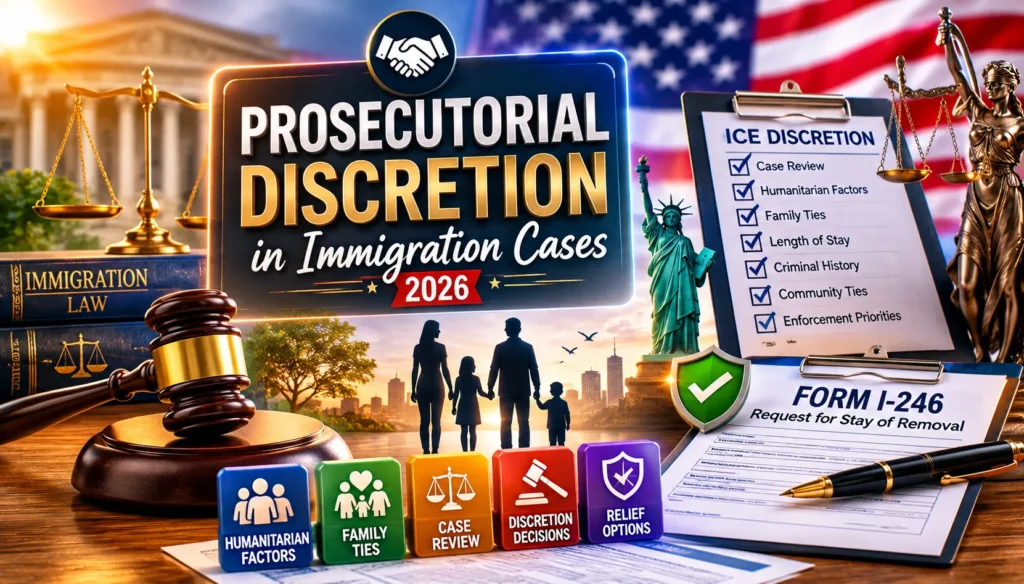
Push for prosecutorial discretion. ICE sometimes closes low-priority cases. Timing aligns with policy shifts.

Deportation Defense Strategies to Stop Removal Fast

How to Deal with ICE

How to deal with ICE demands calm and rights knowledge. Never sign anything without counsel. Deportation defense strategies begin with silence—say you want a lawyer.

ICE visits? Ask for a warrant. Record interactions safely. A deportation defense lawyer follows up immediately.

Post-arrest, fight detention. Bonds under $10,000 happen with strong cases. Track record matters.

How to Avoid Deportation Long-Term

How to avoid deportation involves relief forms. U-visas for crime victims pair with deportation defense strategies. T-visas help trafficking survivors.
Waivers cover old convictions. 212(h) forgives some crimes with rehab proof. Build moral character evidence.

Family petitions speed adjustments. Spouses or kids file I-130s. Courts prioritize these.

How to Fight Deportation Order

How to fight deportation order means appeals. File within 30 days to BIA. Deportation defense strategies reopen cases on new evidence.

Motions to reconsider fix errors. Stay requests halt removal during review. Wins reverse orders.

Federal court follows if needed. Circuit precedents guide outcomes. Persistence pays.
Can a Lawyer Stop Deportation?

Can a lawyer stop deportation? Absolutely, through smart plays. Removal defense lawyer experts win 40-50% of contested cases. They negotiate dismissals. Precedents like Nightingale’s cases show results. Solo fights fail more often.
Deportation Defense Law Firm USA Choices

Deportation defense law firm USA options span coasts. Texas firms excel in cancellations. NYC handles detained cases. California leads appeals.

More Deportation Defense Strategies

  • Deportation defense strategies extend to Convention Against Torture claims. Prove government harm risk.
  • Prosecutorial discretion closed cases under past admins. Current policies favor merits.
  • How to stop deportation proceedings? File I-246 for stays. Combine with asylum for layers.
  • These deportation defense strategies adapt to facts. Document everything daily.

Frequently Asked Questions

How do you stop deportation if detained?

Immediate bond hearings challenge detention. A deportation defense lawyer argues flight risk low with U.S. ties, family, job proof. Success gets release to fight fully—over 60% win bonds under $20K with prep. File merits hearing next. 

What makes a strong deportation defense?

Long U.S. residency, clean record, family hardship qualify for cancellation. Deportation defense strategies prove “exceptional” impact via letters, finances. Courts grant if 10+ years proven. 

Can asylum halt my removal?

Yes, credible fear interviews start it. Fear persecution on race, religion, politics? Apply within one year. Immigration lawyer for deportation defense builds evidence—wins block deportation. 

How to deal with ICE at home?

Demand warrant through door. No entry without it. Say “I want my lawyer”—stop talking. Deportation prevention lawyer sues violations later. 

Can a lawyer stop deportation after order?

Appeals to BIA reopen cases. Stays prevent flight during review. Removal defense lawyer files motions—reversals happen 30% time.

How to avoid deportation with visa overstay?

Adjustment via family works if entered legally. Waivers fix unlawful presence. Deportation defense strategies combine petitions.

What if I have a criminal record?

212(h) waivers forgive some. Prove rehab, no threat. Deportation defense law firm USA navigates—stays granted often.

How to fight deportation orders solo?

Risky—pro se loses more. Free legal aid via churches, nonprofits. Still, a deportation defense lawyer boosts odds hugely. 

Best deportation defense strategies for families?

Provisional waivers pre-deport. Cancellation shows kid hardship. Courts favor parents. Family unity sways judges; gather school records, doctor notes for emotional/financial proof in deportation defense strategies.

O-1 Visa Approval Rate 2026: Latest USCIS Data, Success Trends & Expert Tips

O-1 visa approval rate 2026

When it comes to working in the United States as a top-level talent, the first thing most people check is the o1 visa approval rate. It tells you whether your dream of moving to the U.S. on the O-1 visa is likely to happen. And let’s be honest — knowing this number helps you plan your next steps without guessing.

Right now, the o1 visa approval rate is strong. Data from USCIS shows that most people who file well-prepared petitions get approved. That’s the good news. The tricky part? You need to know what counts as well-prepared if you want to make sure you’re part of that high approval group.

Why the o1 visa approval rate Matters

Think of the o1 visa approval rate as a success barometer. It’s the percentage of applications USCIS approves. In 2025 and 2026, it’s hovering around 94%, which is pretty high compared to other work visas. But don’t get fooled — this high number isn’t a free pass.

People applying for the O-1 visa are already top of their fields. That means the applicants themselves are strong. The o1 visa approval rate looks good because the pool is already high-quality. If your evidence is solid, you’re likely to get approval. If it’s incomplete or weak, you could be part of the small slice that gets denied.

Current O-1 Visa Approval Rate Trends

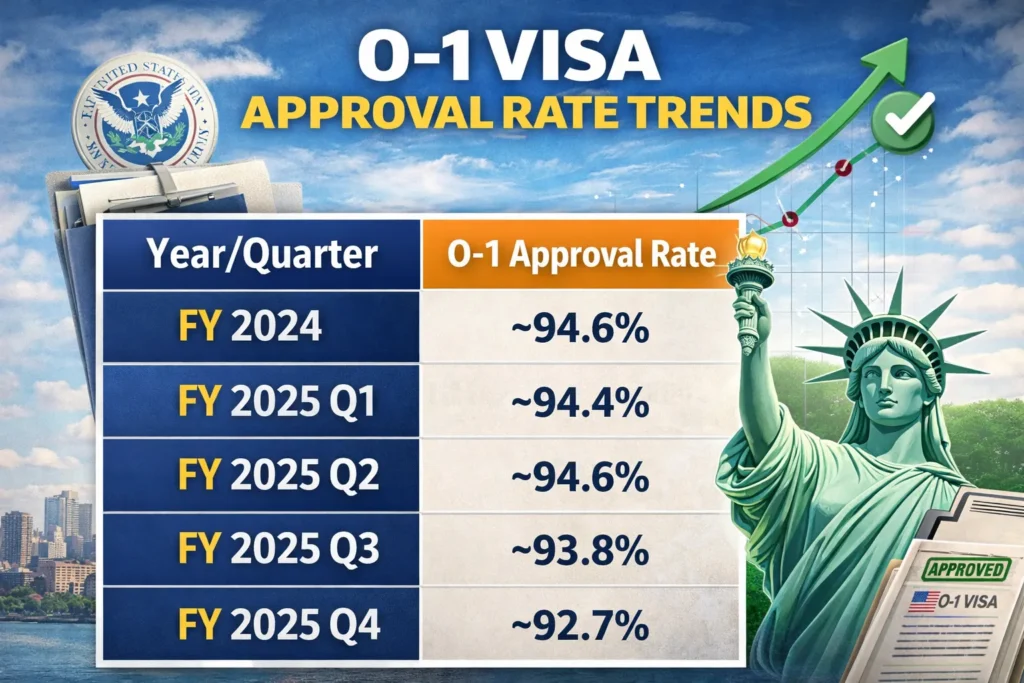
Here’s a simple snapshot of what’s been happening lately:

Year/Quartero1 visa approval rate
FY 2024~94.6%
FY 2025 Q1~94.4%
FY 2025 Q2~94.6%
FY 2025 Q3~93.8%
FY 2025 Q4~92.7%

Notice how stable it is? That’s because USCIS looks for quality, not quantity. Only the well-documented, strong applications get approved, which is why the o1 visa approval rate stays high.

Why the Rate is So High

You might ask: “Why is the o1 visa approval rate so much higher than other work visas?”

  • No cap or lottery: Unlike the H-1B, O-1 visas don’t have a yearly limit. File anytime. If your application is strong, it gets reviewed.
  • Applicant quality: Only highly qualified people apply. If you’re extraordinary in your field, you belong here.
  • Merit-based process: USCIS judges each case on achievements, publications, awards, contracts, and recognition — not luck.

So yes, the odds are good, but it’s still about quality documentation.

O‑1 Visa Categories

Understanding your category is crucial because it affects approval odds:

O‑1A – Business, Science, Education, Athletics

  • For extraordinary ability in non-arts fields
  • Evidence includes awards, publications, salary comparisons, and recognition

O‑1B – Arts & Entertainment

  • Focuses on creative achievements: film, theater, music, and visual arts
  • Evidence includes contracts, media coverage, and expert recommendation letters

Both categories require detailed evidence. This is where o1b visa requirements come into play for artists and performers.

o1 visa acceptance rate

Eligibility Criteria That Matter

Let’s break down o1 visa eligibility criteria in practical terms:

  • Major awards or prizes in your field
  • Memberships in organizations that require extraordinary achievement
  • Published work about you or by you
  • Original contributions that have impacted your field
  • Serving as a judge of others’ work
  • High salary compared to peers

If you tick most of these boxes, you’re setting yourself up for a strong o1 visa approval rate.

How to Apply for O‑1 Visa

Here’s a real-world, step-by-step guide:

  1. Find a U.S. employer or agent – Your petition must have a sponsor.
  2. Fill out Form I‑129 – USCIS uses this form to start your petition.
  3. Collect evidence – Media coverage, awards, letters of recommendation, contracts.
  4. Get an advisory opinion – Sometimes needed from experts in your field.
  5. Submit to USCIS – Don’t forget fees like the o1 visa application fee or optional premium processing.
  6. Wait for the decision – Standard processing can take months; premium processing is faster.

Doing these steps right dramatically improves the o1 visa approval rate for your application.

Costs to Expect

  • O‑1 visa application fee: Paid by the employer
  • Premium processing: Optional, speeds approval to ~15 days
  • Legal fees: Hiring an immigration lawyer for o-1 visa can make a difference
  • Document prep and travel: Minor but essential

Investing upfront often leads to higher approval odds, which is why many applicants consider legal guidance worth it.

Processing Times

  • Standard: Several months depending on USCIS workload
  • Premium: About 15 business days

Fast processing doesn’t improve approval chances, but incomplete or weak evidence will hurt. Remember, the o1 visa approval rate counts only complete, strong applications.

Role of a Lawyer

A lawyer isn’t required, but they can help you:

  • Structure evidence effectively
  • Avoid mistakes that trigger RFEs (Requests for Evidence)
  • Ensure your petition tells a clear story of extraordinary ability

Many applicants see their o1 visa approval rate improve with legal support.

O‑1 to Green Card

Can an O‑1 lead to permanent residency? Yes, via routes like:

  • EB‑1A Extraordinary Ability
  • NIW (National Interest Waiver)

Timing depends on your case and the green card category. Planning early ensures smooth transition and maximizes the likelihood of approval.

Common Misconceptions

  • O-1 is easy – Wrong. Approval rate is high because applicants are strong, not because standards are low.
  • Premium processing guarantees approval – Nope. It only speeds decision.
  • No lawyer means rejection – Possible, but mistakes are more likely without guidance.

Tips to Maximize Your Approval

  • Prepare evidence early and thoroughly
  • Highlight awards and media coverage
  • Include letters from recognized experts
  • Don’t underestimate formatting and organization
  • Consider hiring an immigration lawyer for o-1 visa

Strong applications naturally boost your o1 visa approval rate.

Frequently Asked Questions

What is the current o1 visa approval rate?

The o1 visa approval rate is around 93–94% based on the latest USCIS data for 2025 and early 2026, reflecting strong approval odds for well-prepared petitions.

Does a high o1 visa approval rate guarantee acceptance?

No. Each application is judged individually. High approval rate only means well-prepared cases usually get approved.

How long does O‑1 visa processing take?

Standard processing takes months; premium processing is about 15 business days. Complete evidence improves your odds.

What are the main O‑1 visa eligibility criteria?

Awards, publications, original contributions, judging work, high salary, and expert recognition are key criteria.

Do I need an immigration lawyer for O‑1 success?

Not mandatory, but lawyers can organize evidence, avoid mistakes, and increase approval chances.

How much does an O‑1 visa cost?

Application fee, optional premium processing, legal fees, and documentation costs make up the total expenses.

Can an O‑1 visa lead to a green card?

Yes, through EB‑1A or NIW. Each path has separate requirements and timelines.

Does premium processing affect approval?

No. It only speeds up decision times; approval depends on evidence strength.

What’s the difference between O‑1A and O‑1B?

O‑1A is for business, science, athletics; O‑1B is for arts and entertainment. Evidence requirements differ.

What happens if my O‑1 is denied?

You can respond to an RFE or reapply with stronger evidence. Understanding reasons for denial improves future chances.

H-1B Lottery 2026: Step-by-Step Registration Guide, Latest News & Approval Rates

h-1b visa approvals 2026

Right now, h1b lottery news is not just updates. It is a signal. The system is getting tighter, more competitive, and less forgiving.

More people are applying. Fewer mistakes are being overlooked. And the gap between a strong application and a weak one is becoming very obvious.

Anyone planning for 2026 can already feel the shift. Preparation is starting earlier. Employers are being more careful. Applicants are paying attention in a way they did not before.

That is what the current h1b lottery news is really showing.

What the H-1B lottery actually feels like today?

On paper, it looks simple. A cap, a lottery, a selection.

In reality, it feels like pressure from the start.

The latest h1b lottery news shows that demand keeps growing while the number of visas stays fixed. That creates a situation where even strong candidates are not guaranteed selection.

What is happening behind the scenes

  • Employers are becoming selective before even submitting entries
  • Applicants are preparing months in advance
  • Every small detail is being double-checked
  • Risk is being taken more seriously

The system has not changed overnight, but the way people approach it has.

Step-by-step process, explained the way people experience it?

The visa application process USA is structured, but it does not always feel straightforward when going through it.

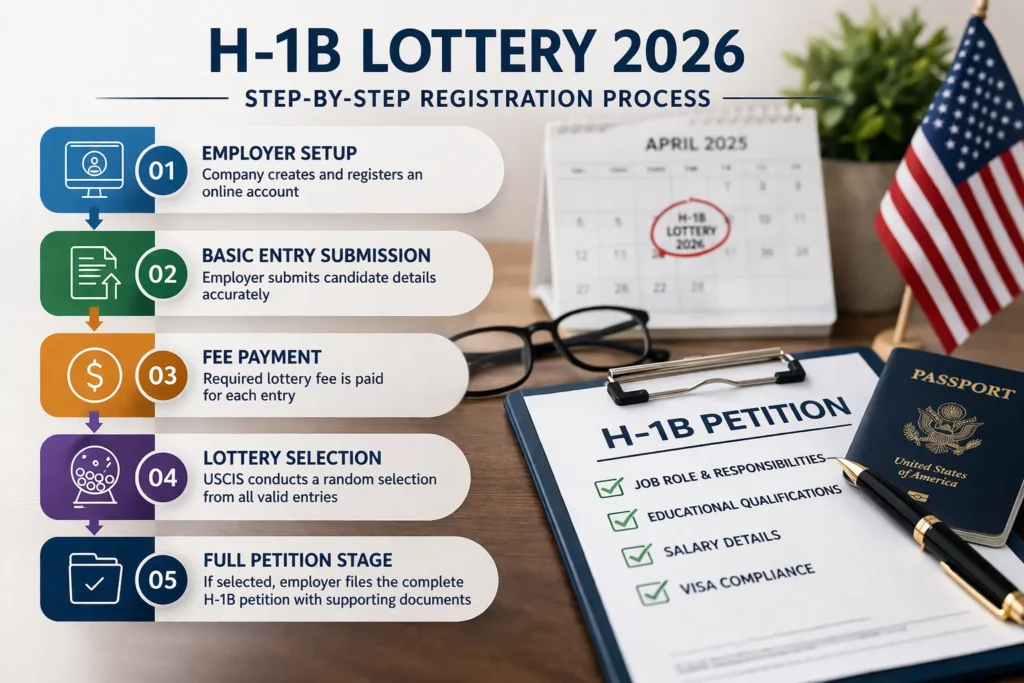
Step 1: Employer setup

Everything starts with the employer. Without a registered account, nothing moves forward.

Step 2: Basic entry submission

This part looks simple, but accuracy matters. Even small errors here can create problems later.

Step 3: Fee payment

Each entry requires a fee. The latest news on h1b keeps hinting that costs may increase, which is already changing how employers submit applications.

Step 4: Lottery moment

This is the waiting phase. No control, just selection based on chance.

Step 5: Full petition stage

This is where everything becomes real. Documents, proof, compliance, everything is reviewed carefully.

The current h1b lottery news keeps highlighting that most problems do not happen in the lottery. They happen after selection.

h-1b visa approvals in us

Latest h1b lottery news and what people are adjusting to

The latest h1b lottery news is not dramatic, but it is very clear.

Things are getting stricter, smarter, and more controlled.

What people are noticing

  • Duplicate applications are being tracked faster
  • Employers are being questioned more
  • Job roles are being reviewed in detail
  • Policy talks like trump new h1b fee are coming back into discussions

The latest news of h1b visa also shows that authorities are not just checking documents. They are checking intent.

Approval rates are changing, slowly but clearly

Approval rates are still high, but they are moving in one direction.

Down.

YearApproval RateRejection Rate
202297%3%
202395%5%
202492%8%
202590%10%

It does not look like a sharp drop, but it feels different when applying.

The shift in h1b visa rates is making applicants more cautious and more prepared.

What really influences h-1b visa approvals in us

Approval is not random. It follows a pattern.

The pattern is simple. Clear, complete, and compliant applications move forward.

What actually matters

  • A job role that clearly requires specialized skills
  • A degree that matches the role
  • Salary that meets required standards
  • Full alignment with visa legal requirements

The truth behind h-1b visa approvals in us is that weak explanations do not hold up anymore.

Why the h1b visa rejection rate feels higher now

The h1b visa rejection rate is rising, but it is not because the system is unfair.

It is because the system is stricter.

What is causing rejections

  • Missing or unclear documents
  • Job descriptions that do not make sense
  • Employers not meeting expectations
  • Small errors that were ignored before

Recent h1b lottery news keeps repeating the same pattern. Most rejections come from things that could have been fixed early.

Where h1b immigration lawyers fit into all this

More applicants are turning to professionals, not because they have to, but because they want to avoid risk.

What changes with proper guidance

  • Applications are cleaner
  • Documents are stronger
  • Mistakes are reduced
  • Responses to issues are handled better

Working with experienced h1b immigration lawyers is becoming less of an option and more of a strategy.

Latest news on h1b and what people are expecting next

The latest news on h1b is pointing toward continued tightening.

Not sudden changes, but steady ones.

What people are preparing for

  • Higher costs
  • More checks on employers
  • Stronger tracking systems
  • Less tolerance for errors

Following h1b lottery news regularly is helping applicants stay ready instead of reacting late.

What a strong application looks like in 2026

A strong application does not look complicated. It looks clear.

What stands out

  • Clear job role with defined responsibilities
  • Strong link between education and position
  • Complete and accurate documentation
  • No inconsistencies

The trend in h-1b visa approvals 2026 shows that clarity is winning over complexity.

How h-1b visa news is affecting decisions globally?

Applicants are not just applying anymore. They are planning.

What is changing worldwide

  • People are choosing employers more carefully
  • Applications are being timed strategically
  • Costs are being considered early
  • Backup plans are being created

Regularly following h-1b visa news is becoming part of the process itself.

Mistakes that quietly ruin chances

Some mistakes do not look serious at first, but they have real consequences.

What keeps showing up

  • Outdated information being used
  • Ignoring latest news of h1b visa
  • Rushing submissions
  • Weak employer support

The pattern seen in h1b lottery news is consistent. Most failed applications could have been stronger.

Conclusion:

The process is not impossible. But it is no longer forgiving.

It rewards clarity and preparation. It rewards attention to detail.

And it punishes anything rushed or unclear.

Staying updated with h1b lottery news is no longer optional. It is part of the process.

Frequently Asked Questions

How does the H-1B lottery actually work in real terms?

When applications exceed the limit, a random selection happens. Only selected entries move forward to the full petition stage where approval is based on detailed review.

Are h1b visa rates still high for approvals?

Approval rates are still relatively high, but they are slowly decreasing as scrutiny increases and applications are reviewed more carefully.

Why is the h1b visa rejection rate increasing now?

Rejection rates are rising because of stricter rules, better fraud detection, and closer review of both employers and job roles.

What is the visa application process USA for H-1B applicants?

It starts with employer registration, followed by lottery selection, then full petition submission, and ends with approval based on compliance and documentation strength.

Do h1b immigration lawyers really make a difference?

They help reduce mistakes, improve application quality, and handle complications, making the overall process smoother and more reliable.

What are the visa legal requirements for H-1B?

Applicants must have a relevant degree, a valid job offer, and meet wage and labor standards set by US immigration authorities.

What is the impact of trump new h1b fee discussions?

Proposed fee increases may raise costs for applications and encourage more careful and limited submissions by employers.

How can someone realistically improve their chances?

While selection is random, strong preparation, accurate documents, and staying updated with h1b lottery news can improve overall success chances.

What should applicants expect in h-1b visa approvals 2026?

Applicants should expect stricter evaluations, more competition, and a stronger focus on complete and accurate applications.

ICE Detention & Your Rights: What Immigrants Must Know Immediately

ICE detention process

ICE detention hits hard and shakes everyone up. But grabbing your rights quick and seeing the steps clear makes all the difference. U visa holders, immigrants, even American citizens caught by mistake—move fast and sharp every time. This guide lays out what comes next, smart moves to make, and ways to shield yourself plus family.

What Exactly Happens in ICE Detention?

When ICE detention occurs, it means U.S. Immigration and Customs Enforcement has taken you into custody. People get detained for different reasons—maybe there’s an immigration issue, or ICE thinks you might be a risk. It could even be a mistake.

Here’s the thing: detention doesn’t automatically mean deportation. But it’s serious, and knowing what’s coming can help you prepare.

  • People can be held in local jails, ICE centers, or private facilities.
  • Sometimes detention lasts days, other times it can be weeks or months.
  • If you’re detained, understanding your options early is key.

Who Can ICE Detain?

You might think only undocumented immigrants get detained, but that’s not the whole story. ICE can even mistakenly detain an American citizen detained by ICE.

Here’s who’s usually at risk:

  • People with expired visas or undocumented status
  • ICE detention of U visa holder can happen if they are involved in an investigation
  • Those with past criminal records or immigration violations
  • Mistaken cases, including citizens

The main point: anyone can be at risk if ICE thinks there’s a reason.

What to Do If ICE Shows Up at Your Door

One of the most common questions is, what to do if ICE comes to your door. Here’s the straight answer:

  1. Don’t open the door right away. ICE agents usually need a signed warrant.
  2. Ask to see the warrant. Make sure it has your name and address.
  3. Stay calm and don’t provide false information. Don’t sign anything without talking to a lawyer.
  4. Call an immigration attorney immediately. They know exactly what to do.
  5. Write down everything. Names, badge numbers, and details matter.

Can ICE Really Deport You for No Reason?

A lot of people ask, can ICE deport you for no reason? The short answer is no. ICE needs a legal reason:

  • Breaking immigration laws
  • Criminal convictions that affect your status
  • Using fraudulent documents

Even if ICE can’t just take you for no reason, deportation can happen fast. Knowing your immigrant rights in detention can save you from making mistakes.

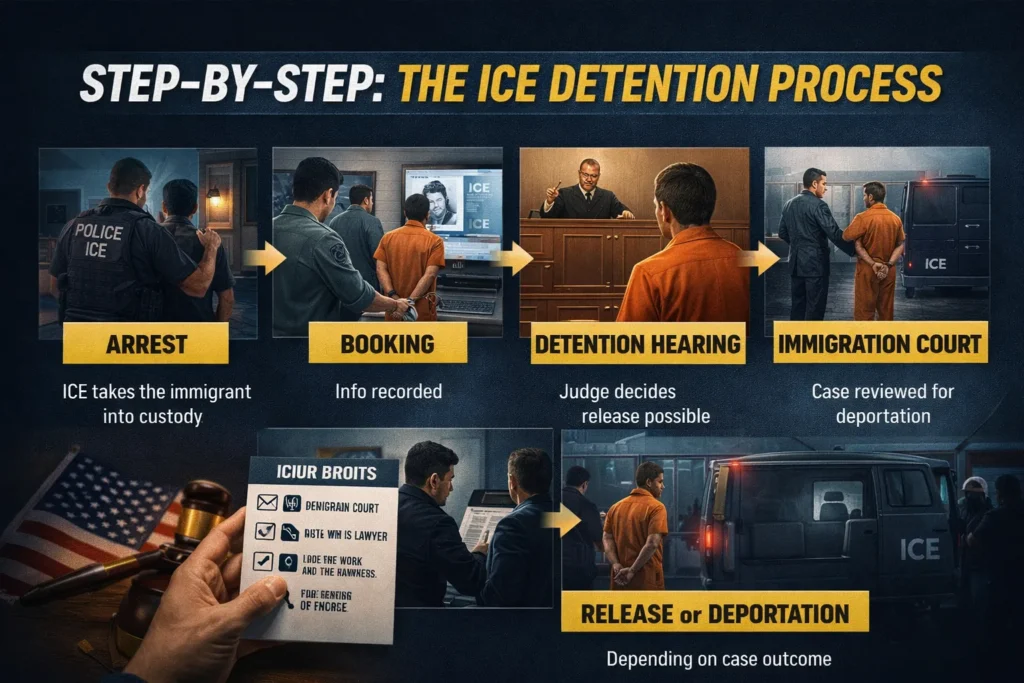
Step-by-Step: The ICE Detention Process

The ICE detention process might seem confusing, but here’s what usually happens:

StepWhat HappensNotes
ArrestICE takes the immigrant into custodyCould happen at home, work, or during a routine check
BookingInfo recordedFingerprints, photos, and background details
Detention HearingJudge decides whether release is possibleBond hearings may be scheduled
Immigration CourtCase reviewed for deportation or reliefLawyer strongly recommended
Release or DeportationDepending on the case outcomeICE detention release option may be available
immigrant rights in detention

Bond Hearings: Your Chance for Freedom

If you’re eligible, bond hearings immigration court can help you get out while waiting for your case. Here’s what to know:

  • Bond is money you pay to guarantee you show up in court
  • Eligibility depends on history, status, and risk of fleeing
  • Having a lawyer makes a big difference

How to Get Out: ICE Detention Release Options

Even in detention, there are ways to get released. Options include:

  • Parole for humanitarian reasons – emergencies, health issues
  • Bond release – money paid by you or someone you trust
  • Conditional release for U visa holders – if you are helping law enforcement
  • Voluntary departure – leaving without formal deportation

Protecting Your Rights in ICE Detention

Your rights don’t disappear just because you’re detained. You have:

  • The right to a lawyer
  • The right to remain silent
  • The right to contact family or an attorney
  • The right to medical care and humane treatment

Ignoring these rights can hurt your case, so it’s critical to know them.

Common Misunderstandings About ICE Detention

  • ICE doesn’t just knock on doors randomly to deport people.
  • Being detained doesn’t mean immediate deportation.
  • You still have rights even in detention.

Tips to Avoid ICE Detention

  • Keep your immigration documents current
  • Follow all visa rules carefully
  • Consult a lawyer if unsure about paperwork or risks
  • Know local ICE office contacts for emergencies

Conclusion

ICE detention can feel overwhelming, but being informed makes a huge difference. Knowing the process, your rights, and your options is the best way to protect yourself. Whether you are a U visa holder, undocumented, or even a citizen detained by mistake, acting fast and smart matters.

Frequently Asked Questions

How long can ICE detention last?

ICE detention might run just days or stretch months, all based on your court lineup and case twists. Simple stuff clears fast; tough fights drag. Get lawyers pushing hearings to speed things up. 

Can ICE detention of U visa holder happen?

Sure, ICE detention of U visa holder kicks in during checks or probes, but bonds or parole often get you out quick. Clean records help big time. Call your sponsors right off. 

What to do if ICE comes to your door without warrant?

Don’t open up—ask them to slide a judge-signed warrant under the door, then call your immigration lawyer fast. Keep quiet about your status. Film it if you can from inside. 

Can ICE deport you for no reason?

Nope, they need real reasons like visa slips or crimes—hearings come first every time. Bad cases fall apart on appeal. Stay silent to dodge traps.

What happens in the ICE detention process?

ICE detention process starts with grab and booking—prints, pics, quick review. Then hearings on bonds or removal, wrapping in release or orders. Check progress online easy. 

American citizen detained by ICE—what then?

Yeah, it happens by mix-up in raids or ID flubs. Show birth cert or passport for same-day out. Take them to court later for the hassle. 

Bond hearings immigration court—can you get one?

Most can, where judges check risks and set bond cash. Jobs and family ties tip scales your way. Gather proof quick. 

What ICE detention release options are there?

Bonds pay for out, parole on mercy, check-ins for supervision, or just your word to show up. U visa gets extras. Lawyers find the best route fast. 

Immigrant rights in detention—name a few?

Keep quiet sans lawyer, grab counsel free, get medical help, no rough treatment. Phones link family pronto. Hotline any issues. 

How to dodge ICE detention upfront?

Update papers, follow rules, chat lawyers regular. Carry ID always, steer clear of trouble spots, set family plans.

Asylum vs Refugee Status: Key Differences & Eligibility Explained

refugee vs asylee explained

Asylum vs refugee status trips up many folks running from danger. Both protect people from harm back home, but asylum vs refugee status depends on where you are when you ask for help. This simple guide explains everything step by step.

Core Meanings

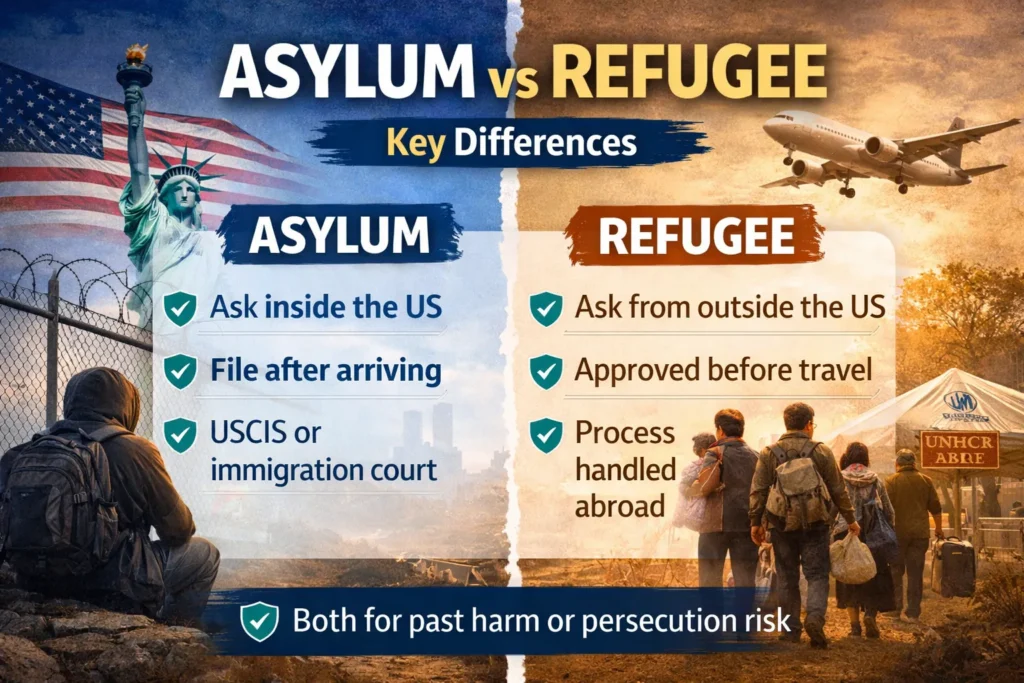
Asylum vs refugee status boils down to timing and place. A refugee asks for help from outside the United States. They get checked and approved before coming in. An asylee asks once already inside the country or at the border.

  • Refugee waits abroad for a green light to enter.
  • Asylee files papers right here in the US.

Difference between asylum and refugee shows in the process. Both need proof of fear from race, religion, politics, nationality, or social group. Asylum vs refugee status saves lives either way.

Quick Comparison Table

FeatureAsylum (asylum vs refugee status)Refugee (asylum vs refugee status)
Where You ApplyInside US or borderOutside US
When to ApplyWithin 1 year of arrivalBefore travel to US
Who Handles ItUSCIS or courtState Department first
Work PermitAfter 150 days waitingRight on arrival
Green Card PathAfter 1 year as asyleeAfter 1 year in US

This setup makes asylum vs refugee status clear at a glance.

Who Qualifies for Asylum

Asylum eligibility requirements USA demand real fear of persecution. Show past harm or danger ahead on those five grounds. Government or gangs it can’t stop must cause it.

  • No safe spot to hide in your home country.
  • File soon after landing, unless things changed.
  • Skip if you committed big crimes or resettled safe elsewhere.

Who qualifies for asylum faces bars like US visa overstay sometimes. Asylum vs refugee status shares rules, but asylum proves it in hearings here.

Refugee Rules

Refugee status requirements USA match asylum fears. Apply overseas through UN or US posts. Caps limit spots each year, like 125,000 lately.

  • Get referred by family, UN, or embassy.
  • Pass health and security tests over 18 months.
  • Travel on special papers once okayed.

Who qualifies as a refugee gets resettlement help on arrival. Asylum vs refugee status means planned entry beats sudden pleas.

Asylum Steps

Asylum process step by step goes smooth if prepared.

  1. Fill free Form I-589 with USCIS if safe, or court if facing removal.
  2. Give fingerprints for checks.
  3. Attend interview: bring proof, country reports, witnesses.
  4. Get decision—win, lose, or more court.

Deportation defense asylum stops removal if claimed early. Asylum vs refugee status tests patience with backlogs over a million cases.

difference between asylum and refugee

Refugee Journey

Refugee resettlement process starts far away.

  1. Sign up with UN refugee agency.
  2. US interviews abroad.
  3. Learn US ways in classes.
  4. Fly in, meet helpers for home and job.

Refugees grab benefits quick like cash aid. Asylum vs refugee status gives them structure asylum lacks.

Other Protections

Immigration protection programs beyond asylum vs refugee status help too. Temporary Protected Status covers war zones. U visas aid crime victims.

ProgramWhat It Does
AsylumStay if persecuted
RefugeeEnter safe from afar
TPSPause return for disasters
DEDShort deferral for some nations

Asylum vs refugee status fits pure fear cases best.

Benefits Unlocked

Win asylum vs refugee status and work legally fast. Travel abroad, bring family later. Green card opens after one year, citizenship in five.

  • Health aid, food help available.
  • No fear of being sent back.

Refugee vs asylee explained notes refugees must adjust status; asylees choose.

Legal Support Tips

Seek immigration lawyers early when tackling asylum vs refugee status claims. They spot key exceptions to deadlines, gather strong evidence like country reports and witness letters, and guide filings through USCIS or court backlogs to boost approval chances.

Free clinics, nonprofits like Catholic Charities, or legal aid groups help low-income folks too, especially for deportation defense asylum. Prep personal stories, medical records, and news clippings ahead—strong cases speed up paths to safety, work permits, and green cards down the line.

Conclusion:

Long waits hit everyone. Asylum vs refugee status needs docs like affidavits. Hire lawyers for deportation defense asylum. Changed laws or dangers extend deadlines. Asylum vs refugee status demands truth—fakes get caught.

Frequently Asked Questions

Main difference between asylum and refugee?

Asylum vs refugee status splits by spot: asylum inside US, refugee outside. Processes and speeds vary but protection stays same against harm.

Asylum seeker vs refugee definition?

Seeker waits for asylum call inside; refugee arrives approved. Seekers risk denial; refugees step in secure. 

Refugee vs asylee explained?

Refugee pre-approved entry; asylee wins post-arrival fight. Refugees aid quicker; asylees court battle. 

Asylum eligibility requirements USA?

Prove fear on race, faith grounds within year. No safe home hideout needed.

Refugee status requirements USA?

Overseas checks by US officials ensure safety. UN referral or embassy nod required, plus fit yearly cap like 125,000 spots. No serious crime bars or prior safe resettlement.

Who qualifies for asylum?

Face past harm or real fear of persecution on race, religion, politics, nationality, or social group. No safe spot to relocate in home country. File within one year of US arrival, exceptions for changes.

Who qualifies as a refugee?

Well-founded fear of persecution on same five grounds, vetted abroad first. UN or US channels handle interviews, medical, security screens. No immigration bars like crimes apply.

Asylum process step by step?

File free Form I-589 with USCIS or in court if facing removal. Submit biometrics for checks, then attend interview with proof and witnesses. Decision grants status, denies, or sends to further hearings.

Refugee resettlement process?

Register with UN abroad, get US referral for vetting interviews. Complete cultural training, health/security clearances over 18-24 months. Arrive on special visa with ORR aid for home, jobs.

Asylum vs refugee status stop deportation?

Yes, both block removal to dangerous home country once approved. Key tool in deportation defense during proceedings. Secures stay, work rights, path to green card.

I-246 Form Guide: How to Apply for a Stay of Removal and Stop Deportation

I-246 Form Guide: Stop Deportation Fast

i 246 form is the form people turn to when deportation feels close and time feels short. It is used to request a stay of removal, which means asking the government to pause deportation for a period of time.

This form does not erase a deportation order. It does not cancel a judge’s decision. What it does is powerful in a different way. It asks for time. And sometimes time is exactly what is needed to fix a case, file new paperwork, or protect a family.

Many people search for:

  • how to stop deportation order
  • how to prevent deportation
  • stay of deportation
  • i 246 stay of removal
  • i 246 immigration form

Those usually come from fear and urgency. The i 246 form is often the next step after a final removal order has already been issued.

What Is a Stay of Removal?

A stay of removal means deportation is paused temporarily. This request does not erase consequences. Permanent protection does not follow. A green card is not awarded. The benefit is limited to a short postponement.

That delay can allow someone to:

  • File a motion to reopen
  • Wait for a pending visa petition
  • Show new evidence
  • Handle a medical emergency
  • Protect U.S. citizen children from sudden separation

The application for a stay of deportation or removal is filed directly with ICE, not immigration court.

Who Usually Files the i 246 form

The i 246 form is generally filed by someone who:

  • Already has a final order of removal
  • Is checking in with ICE
  • Has received notice of deportation
  • Has new immigration relief pending

This is not an early-stage form. It is used when the case has reached a serious point.

The i 246 immigration form can be considered when there is:

  • A pending family petition
  • A U visa or T visa application
  • A medical crisis
  • Strong humanitarian reasons
  • A motion to reopen in progress

Each request is reviewed individually. Approval depends on the facts.

When Should the i 246 form Be Filed

Timing matters more than most people realize. The i 246 form should be filed before removal is carried out. Waiting too long can reduce options.

It is best to file when:

  • ICE gives notice of removal
  • New evidence becomes available
  • A petition is filed that could change status

The earlier the request is submitted, the more opportunity there is for review.

What Documents Are Needed

Filing the i 246 form requires preparation. Strong documents make a stronger case.

Basic Requirements

  • Completed and signed i 246 form
  • Filing fee payment
  • Copy of removal order
  • Government ID
  • Proof of current address

Supporting Evidence Can Include

  • Medical records
  • Letters from doctors
  • Proof of U.S. citizen children
  • Marriage certificates
  • Employment verification
  • Proof of tax payments
  • Evidence of good moral character

When requesting a stay of deportation, proof is everything. Statements without evidence are usually not enough.

Step by Step: How the Process Works

Step 1: Complete the Form Carefully

Every detail must match immigration records. Name, A-number, and address must be accurate. Even small errors can cause delays.

Step 2: Clearly Explain the Reason

This part carries weight. The explanation should show:

  • Why removal should be delayed
  • What legal relief is pending
  • What hardship deportation would cause

Clarity and honesty matter.

Step 3: Attach Strong Evidence

The application for a stay of deportation or removal is discretionary. ICE officers look for compelling reasons.

Step 4: File with the Correct ICE Office

The i 246 immigration form is submitted to the local ICE Enforcement and Removal Operations office. It is not mailed to USCIS and not filed in immigration court.

Step 5: Attend the Appointment

An in-person visit may be required. Officers may ask questions. Compliance history will be reviewed.

How ICE Decides

Approval of the i 246 stay of removal depends on positive and negative factors.

Positive Factors

  • Long time living in the United States
  • U.S. citizen spouse or children
  • Serious medical conditions
  • No criminal history
  • Regular ICE check-ins

Negative Factors

  • Criminal convictions
  • Missed supervision appointments
  • Prior immigration fraud
  • Public safety concerns

ICE has discretion. That means there is no automatic approval.

How Long Does a Stay Last

If approved, a stay of removal can last months or up to one year. Some cases allow renewal. Others do not. There is no guaranteed timeline for a decision. Some approvals come quickly. Others take weeks.

Can the i 246 form Permanently Stop Deportation

The i 246 form does not permanently cancel removal. It creates time. That time can be used to:

  • File a motion to reopen
  • Apply for adjustment of status
  • Seek humanitarian protection
  • Strengthen a pending petition

For many families, that pause prevents immediate separation and allows legal solutions to move forward.

Important Risks to Understand

Filing the i 246 form requires direct contact with ICE. That means:

  • Officers will review the full history
  • Denial can lead to removal
  • Strong preparation is critical

Legal guidance is highly recommended before filing, especially in complex cases.

Frequently Asked Questions

What is the i 246 form used for?

The i 246 form is used to request a temporary stay of removal from ICE. It asks the government to delay deportation so that pending immigration relief or new evidence can be properly reviewed.

How does a stay of removal help stop deportation?

A stay of removal temporarily pauses deportation enforcement. It gives time to file motions, submit petitions, or present humanitarian reasons that may change the outcome of the case.

Can filing the i 246 immigration form automatically stop removal?

No, filing alone does not automatically stop removal. ICE must review and approve the request before deportation is officially paused.

What is included in the application for a stay of deportation or removal?

The application includes the completed form, filing fee, copy of removal order, identification documents, and strong supporting evidence explaining why deportation should be delayed.

How to stop deportation order after it becomes final?

Options may include filing the i 246 stay of removal, submitting a motion to reopen in immigration court, applying for asylum based on new evidence, or pursuing adjustment of status if eligible.

How long does the i 246 stay of removal last?

If approved, the stay may last several months or up to one year depending on ICE discretion and case circumstances. Some stays may be extended with additional proof.

Can someone with a criminal record apply for a stay of deportation?

Yes, but criminal history can negatively impact approval. ICE weighs public safety concerns and overall conduct before making a decision.

Where is the deportation form filed?

The deportation form requesting a stay is filed with the local ICE Enforcement and Removal Operations office, not with USCIS or immigration court.

Can a stay of deportation be renewed?

In some situations, renewal is possible if strong reasons still exist. Updated documentation and continued compliance are usually required.

Green Card vs. Visa: What’s Real Difference and Which One Do You Need?

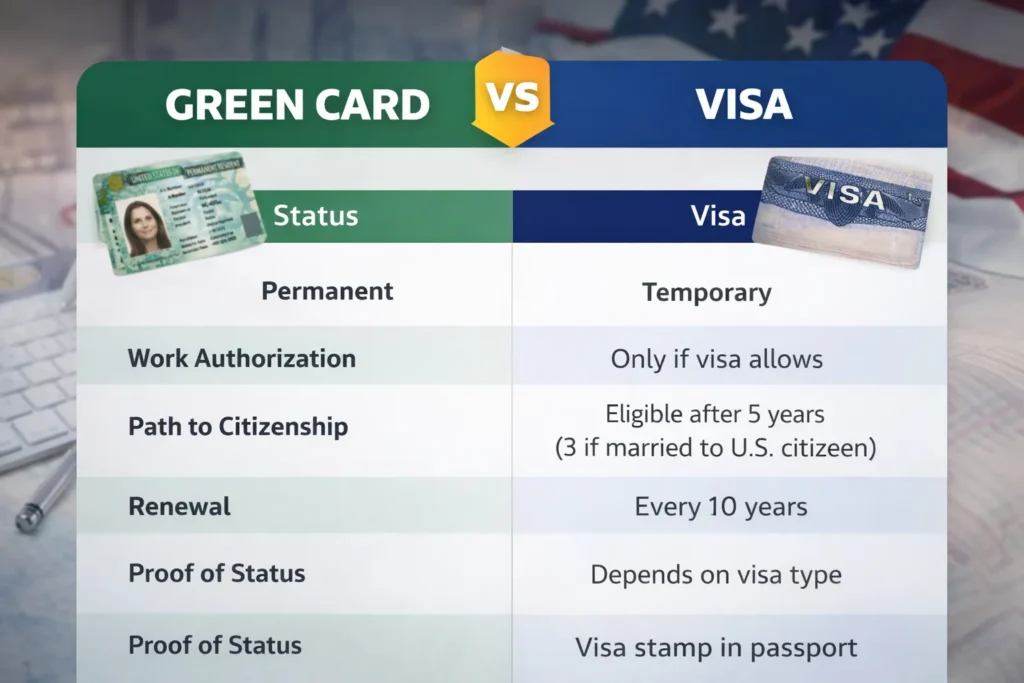
Green Card vs Visa

So you’re thinking about moving to the United States, or maybe staying longer, and you’ve probably heard people talk about green card vs visa. The truth is, these two are very different, even though lots of people use the words like they mean the same thing. Knowing which one you need can save a lot of headaches. Let’s break it down clearly.

What Exactly is a Green Card?

A green card, officially called a U.S. Alien Registration Card, is your proof that you can live in the U.S. permanently. Think of it like your permanent ID to the country.

With a green card, you can:

  • Work anywhere in the U.S., for any employer
  • Travel in and out of the U.S. with fewer restrictions
  • Apply for citizenship after a few years

Basically, if your goal is to make the U.S. your home, the green card is what you want.

And What About a Visa?

A visa is a temporary permission slip to enter the U.S. It tells the government why you’re coming and for how long you can stay.

Some common visa types are:

  • Tourist visas
  • Student visas
  • Work visas like H-1B
  • Business visas

Green Card vs Visa: The Key Differences

It’s easier to see the difference in a table:

FeatureGreen CardVisa
StatusPermanentTemporary
Work AuthorizationYes, any employerOnly if visa allows
TravelEasier, re-entry allowedDepends on visa validity
Path to CitizenshipEligible after 5 years (3 if married to U.S. citizen)No
RenewalEvery 10 yearsDepends on visa type
Proof of StatusU.S. Alien Registration CardVisa stamp in passport

See that? One gives stability, the other just lets you visit or work for a while.

Types of Green Cards

Not all green cards are the same. There are a few main paths:

  • Family-Sponsored – Close relatives of U.S. citizens or green card holders.
  • Employment-Based – Employers can sponsor you if they want you long-term.
  • Diversity Lottery – Random chance for people from eligible countries.
  • Refugees or Asylees – If you were admitted as a refugee or granted asylum.

Each type has its own rules, but the goal is the same: permanent residency.

Types of Visas

Visas also come in different flavors, depending on why you’re coming:

  • Nonimmigrant Visas – Short-term stay for travel, school, or work. Example: H-1B.
  • Immigrant Visas – These are for people planning to live permanently. Once approved, you get a green card.

It’s easy to see why people mix up immigration visa vs green card. One is temporary, the other is permanent.

How to Apply for a Green Card

Applying for a green card might sound scary, but it’s really about following steps:

  1. Check if you’re eligible – through family, work, diversity lottery, or asylum.
  2. File the right petition – Form I-130 for family, I-140 for work.
  3. Submit the U.S. Green Card Application Form – I-485 if you’re in the U.S., DS-260 if you’re abroad.
  4. Attend biometrics – fingerprints, photo, and sometimes an interview.
  5. Wait for approval, then receive your green card.

It can take months or years depending on the category, but it’s the legal path to permanent residency.

Green Card Renewal Process

Green cards last 10 years, so eventually, you’ll need to renew.

  • File Form I-90 online or by mail
  • Update your information if anything changed
  • Pay the renewal fee
  • Receive a new card

Keep this up to stay in immigration compliance and avoid trouble.

Visa Extensions and Changes

Visas aren’t permanent. If you’re on a work or student visa:

  • Apply for an extension before it expires
  • Employers can file extensions for work visas
  • If you want permanent residency, apply for a green card before your visa runs out

That’s why understanding green card vs work visa is so important if your goal is staying long-term.

Green Card vs Work Visa

Here’s the simple truth:

  • Work visas are temporary and usually tied to one employer
  • Green cards give you full freedom to work and live in the U.S. permanently

Some people start with a work visa and later get sponsored for a green card. If your employer is willing, this can be a smooth path.

How to Decide: Green Card or Visa?

Ask yourself:

  • Do I want to live in the U.S. permanently?
  • Am I eligible through family, work, or lottery?
  • Will I need to work for any employer?
  • How often will I travel internationally?

Your answers usually make the choice clear.

Staying Compliant

  • Keep your green card or visa up to date
  • Notify USCIS if you move
  • File taxes correctly for your status
  • Don’t overstay your visa
  • Know what is the visa type for green card if switching

Quick Overview Table: Green Card vs Visa

QuestionGreen CardVisa
Can I live permanently?YesNo
Can I work freely?YesOnly if visa allows
Can I apply for citizenship?YesNo
Renewal needed?Every 10 yearsDepends on type
Travel restrictions?MinimalDepends on visa

Frequently Asked Questions

Can I work in the U.S. if I only have a visa?

Depends which one you’ve got. Some visas, like a work visa or a student visa, let you work legally. But if it’s just a tourist visa — nope, that one’s for vacation, not for a paycheck.

How long can you stay with a green card?

Pretty much forever, as long as you don’t break any rules and renew it every 10 years. 

Do green card holders automatically become U.S. citizens?

You can apply after a few years if you want to, usually five years, or three if you’re married to a U.S. citizen, but it’s totally up to you.

Can I move from a visa to a green card?

Yep, that’s how a lot of people do it. You might get sponsored by your employer, through family, or even win the diversity lottery. It’s called “adjusting your status.”

What happens if my visa expires while I’m still in the U.S.?

Overstaying can cause serious issues like bans or big delays if you ever want to come back. Always renew or extend before it’s too late.

Is the green card lottery actually random?

Only people from certain countries can apply. If you’re eligible, it’s definitely worth a shot.

Do green cards ever expire?

Yeah, every 10 years. It’s like renewing your ID, quick process, just don’t forget about it.

So, should I go for a visa or a green card first?

Usually, start with a visa, it’s faster and simpler. Then once you’re here, if you decide you really want to stay long-term, that’s when the green card makes sense.

EB-1 vs EB-2: Key Differences, Requirements & Which Green Card Is Right for You?

requirements for eb1 visa

When people start comparing EB-1 and EB-2, they usually focus on processing time. They look at visa bulletins. They look at priority dates. But that is not where the decision really begins.

It begins with eb1 requirements.

Before anything else, the question becomes very direct. Does the profile truly meet the standard for EB-1? Not almost. Not close. Clearly.

The eb 1 visa is a first-preference employment-based green card. That means it sits at the top of the employment categories. It moves faster in many cases. It avoids labor certification in most situations. But it demands stronger proof.

The eb2 green card is different. It is more common. It supports advanced degree professionals and individuals with exceptional ability. It is solid and reliable, but it usually requires labor certification and often comes with longer waits.

So the real conversation is not about which is better. It is about which one actually fits the evidence.

What Is EB1 Visa?

Many ask what is eb1 visa and assume it is only for globally famous individuals. That is not accurate.

The eb 1 green card includes three main categories:

  • EB-1A Extraordinary Ability
  • EB-1B Outstanding Professors and Researchers
  • EB-1C Multinational Managers and Executives

Each category has different documentation standards, but all depend on meeting strict eb1 requirements.

EB-1A allows self-petition. No employer is required. That is why so many professionals search how to get eb1 through this route.

EB-1B requires a permanent job offer from a university or research institution.

EB-1C applies to executives and managers transferring from an overseas company to a related U.S. entity.

In every case, approval depends on how clearly the evidence satisfies requirements for eb1 visa.

EB1A Criteria Explained 

EB-1A is often the most discussed category. It gives flexibility, but the review is intense.

Under eb1a criteria, the applicant must show sustained national or international acclaim. That phrase carries weight. Sustained means ongoing recognition. Not one event. Not one promotion.

Examples of qualifying evidence include:

  • Recognized national or international awards
  • Published articles about the applicant
  • Membership in associations requiring outstanding achievements
  • Serving as a judge of others in the field
  • Original contributions of major significance
  • Authorship of scholarly publications
  • High salary compared to others in the industry

Meeting three criteria is the technical requirement. But truly satisfying eb1 requirements means the entire case must show influence and distinction.

The officer reviewing the petition looks at the total picture. Do the achievements demonstrate leadership in the field? Do they reflect real impact?

That is how eb1 criteria for green card approval is evaluated.

Why EB1 Requirements Feel Strict

The reason eb1 requirements feel strict is simple. The category is meant for the top percentage of professionals.

A strong resume is not enough. Years of experience alone are not enough. Even a high salary by itself is not enough.

The petition must show:

  • Recognition beyond one company
  • Influence that extends beyond one project
  • A reputation that reaches national or international level

This is where many applicants miscalculate. They assume qualification based on career length. But EB-1 focuses on distinction, not duration.

EB-2 in Straight Terms

The eb2 green card serves a different audience.

It supports:

  • Professionals with advanced degrees
  • Individuals with exceptional ability
  • National Interest Waiver applicants

Most EB-2 cases require labor certification. That means an employer must prove that hiring the foreign professional will not displace a qualified U.S. worker.

Compared to strict eb1 requirements, EB-2 is more focused on academic credentials, professional expertise, and job necessity.

It is not weaker. It is simply different.

key difference between EB 1 vs EB 2

EB-1 vs EB-2 Comparison

CategoryEB-1EB-2
Preference LevelFirstSecond
Recognition NeededNational or InternationalProfessional Level
Labor CertificationUsually Not RequiredUsually Required
Processing TimeOften FasterOften Slower
Self-Petition OptionYes EB-1AYes with NIW

Meeting eb1 requirements provides faster priority in many cases. But the evidentiary burden is clearly higher.

EB 1 Green Card Qualifications 

When reviewing eb 1 green card qualifications, it is important to focus on quality.

An award must carry weight.
A publication must show real impact.
A leadership role must demonstrate authority.

Every document submitted should clearly connect to requirements for eb1 visa.

Officers are trained to look for depth, not just quantity. A stack of documents without clear alignment to eb1 requirements does not strengthen a case.

How to Get EB1 Without Weaknesses

Many professionals search how to get eb1 quickly. The better question is how to get eb1 correctly.

Strong petitions usually:

  • Align each piece of evidence with specific eb1 requirements
  • Include detailed recommendation letters from independent experts
  • Show measurable results such as citations, industry growth, or recognized contributions
  • Demonstrate consistent recognition over time

The case must tell a clear story. Recognition. Impact. Leadership.

Without clear alignment to eb1 requirements, approval becomes uncertain.

When EB-1 Makes Sense

EB-1 may be the right choice when:

  • There is documented national or international recognition
  • Awards or media features show public distinction
  • Leadership roles demonstrate authority in the field
  • Evidence strongly satisfies eb1 requirements

For applicants from countries facing long backlogs, qualifying under EB-1 can significantly shorten the wait.

When EB-2 Is the Smarter Path

EB-2 may be the better option when:

  • The strongest qualification is an advanced degree
  • Employer sponsorship is available
  • Recognition exists but does not reach extraordinary level
  • The profile does not fully satisfy eb1 requirements

Choosing the category that matches the evidence avoids unnecessary denials and delays.

Conclusion:

The choice between EB-1 and EB-2 is not about preference. It is about fit.

If the profile clearly demonstrates extraordinary ability and meets eb1 requirements, EB-1 offers priority processing and fewer procedural hurdles.

If the evidence reflects strong professional qualifications but not sustained national acclaim, EB-2 remains a reliable and effective route.

The most important step is honest evaluation. Understanding eb1 requirements in practical terms helps determine the strongest path forward.

Frequently Asked Questions

What is the main advantage of eb 1 visa over eb2 green card?

Eb 1 visa holds first preference, speeding visa availability and cutting waits versus eb2 green card backlogs—ideal for urgent family or career moves. 

Are eb1 requirements stricter than eb2 green card standards?

Yes, eb1 requirements demand sustained national/international acclaim, raising the bar higher than eb2 green card focus on degrees or skills. 

Can someone self-petition under eb1 green card?

Yes, eb1 green card EB-1A allows self-petition without sponsors if meeting eb1a criteria—a freedom EB-2 rarely offers. 

Does requirements for eb1 visa skip labor certification?

Requirements for eb1 visa usually eliminate labor certification, streamlining over EB-2’s mandatory PERM tests and delays. 

How many eb1a criteria count for approval?

At least three eb1a criteria like awards or publications must hit, unless a major one-time prize covers it under eb1 requirements. 

Is eb2 green card easier than meeting eb1 requirements?

Generally yes, eb2 green card leans on advanced degrees versus eb1 requirements’ acclaim proof, lowering the entry bar. 

Why does eb 1 visa process faster?

Eb 1 visa first-preference status cuts visa bulletin waits compared to eb1 vs eb2 where EB-2 lags years behind. 

What boosts chances under eb1 criteria for green card?

Strong eb1 criteria for green card evidence like awards, media, leadership roles, pubs, and contributions lifts approval odds high. 

Can eb1 green card petitions shift to eb2 green card?

Yes, if eb1 green card denies, refile under eb2 green card if quals match—many use dual strategies wisely. 

Should filings ignore eb1 requirements checks?

No, skipping eb1 requirements evaluation risks denial and fees, assess honestly first for best eb1 vs eb2 outcomes

H-1B Visa Complete Guide: Attorney Fees, Processing Time & Choosing the Right Immigration Lawyer

h1b visa immigration lawyer

H1b visa immigration lawyer plays a key role right from the start when navigating the complex world of U.S. work visas. Many professionals dream of working in America, but the H-1B process demands precision to avoid delays or denials. This guide breaks it down step by step, covering everything from costs to timelines, so decisions come easier.

What is an H-1B Visa?

H-1B visas get skilled people from other countries into those niche jobs, you know, tech gigs, engineering roles, medical spots, stuff like that. Companies sponsor them ’cause they need that exact skill set and can’t find it around here. They limit it to 85,000 new ones a year: 65,000 regular, another 20,000 if you’ve got a master’s or better, which makes the lottery a real battle.

Think of it like a temporary pass to work here for up to six years, and it often leads to a green card down the line. Rules change all the time lately, so keep sharp. Hook up with a dependable h1b visa immigration lawyer to make sure your papers line up just right with whatever’s current.

H-1B Visa Application Steps

Follow these steps carefully to build a strong case.

  • Start with the employer finding a job match and getting Labor Condition Application (LCA) approval from DOL.
  • File electronic registration in March for lottery selection (now $215 fee for FY2026).​
  • If selected, submit a full I-129 petition with fees and evidence.
  • Wait for USCIS approval, then handle visa stamping abroad or change of status if already in the U.S.
  • Enter the country and begin work, usually October 1 for cap cases.

Each step trips up many without guidance. That’s where experience counts.

H1B Visa Processing Time

H1B visa processing time varies by service center and method. Regular processing takes 3-6 months on average, Texas around 4.5 months, California and Vermont up to 6.

Premium processing speeds it to 15 calendar days for an extra fee. Cap-exempt petitions (like nonprofits) skip the lottery wait. Track your case online, but expect RFEs (Requests for Evidence) to add 1-3 months.​

Factors like workload or complexity stretch timelines. Plan ahead, start early.

Service CenterRegular Processing (80% cases)Premium Processing
Texas4.5 months15 days
California6 months15 days
Vermont6 months15 days

H1B Attorney Fees Breakdown

H1b attorney fees range widely based on case type and firm. New petitions cost $2,500-$5,000, transfers or extensions $1,400-$3,000.

Add USCIS fees: $780 base I-129 (or $460 small employers), $500 anti-fraud for new cases, $1,500-$4,000 ACWIA for larger firms, plus optional premium $2,805.

Total per petition often hits $5,000-$10,000 including everything. Shop around but avoid cheapest options, errors cost more in refiling.

Fee TypeAmount (2026)Notes
Base Filing (I-129)$780 ($460 small)Required for all​
Attorney (New H1B)$2,500-$5,000Varies by complexity​
Premium Processing$2,80515-day turnaround​
ACWIA Training Fee$1,500-$3,000For 26+ employees​

Who Pays H1B Legal Fees?

Employers cover most costs by law, including attorney fees for the petition. Workers sometimes reimburse, but never required for core fees. Dependents’ fees fall on the employee.​

H1b legal fees stay separate from USCIS charges like lawyers bill directly. Get flat-fee quotes upfront to budget right.

H1B visa attorney fees

Choosing the Right H1B Visa Immigration Lawyer

Picking a h1b visa immigration lawyer means checking experience first, look for 100+ successful cases yearly. AILA membership signals credibility.

Read client reviews on success rates, not just stars. Ask about communication, quick responses build trust. Compare fees, services like RFEs, and free consults.​

  • Experience: Years in H1B, approval stats.
  • Reviews: Real client stories on sites like Avvo.
  • Fees: Transparent, no hidden charges.
  • Communication: Email/phone responsiveness.
  • Success: Track record with similar cases.

Why Hire a H1B Lawyer?

DIY risks denials from tiny errors. A h1b visa immigration lawyer spots issues early, gathers strong evidence, and fights RFEs. Success rates jump 20-30% with pros.​ They track changes like FY2026 lottery tweaks, and save time. Employers rely on attorney h1b visa experts for compliance too.

Common H1B Mistakes to Avoid

H-1B applications fail over simple fixes. Watch out for these five mistakes to boost your chances. 

Mistake 1: Wrong LCA Details

LCA stands for Labor Condition Application. It shows your pay must match local rates and job fits rules. Get this wrong, and the Department of Labor rejects it fast—or USCIS later. Always check numbers twice. Have a h1b visa immigration lawyer review before filing.

Mistake 2: No Premium Processing

New jobs start October 1. Regular review takes 3-6 months. Skip the $2,805 premium fee, and you face work delays or gaps. Add premium if dates are tight. H1b attorney fees include this to keep you on schedule.

Mistake 3: Cap-Gap Overlooked

Lottery winners finish school but wait months for approval. Student visas extend to October if you file OPT right. Miss it, and legal work stops. A corporate immigration attorney makes sure this extension kicks in.

Mistake 4: Vague Job Description

List “software developer” without details, USCIS denies for no “specialty occupation.” Show over half the tasks need a college degree. Write clear duties. Let a h1b lawyer sharpen your wording.

Mistake 5: Incomplete Paperwork

I-129 forms need perfect degrees, letters from bosses, and signatures. One missing item ends your case. Review every page. An attorney h1b visa expert catches slips—h1b legal fees prevent refiles.

Avoid these errors, and your H-1B moves forward. Start with a trusted h1b visa immigration lawyer for the win.

Frequently Asked Questions

How much are typical h1b attorney fees for new petitions? 

H1b attorney fees for new H1B run $2,500-$5,000, covering assessment to filing. Complex cases hit higher; always get quotes from multiple h1b visa immigration lawyer firms.

What is the current H1B visa processing time with premium? 

Premium cuts H1B visa processing time to 15 days. Regular takes 3-6 months depending on center. Cap-exempt faster—no lottery wait.

Who is a good corporate immigration attorney for H1B? 

Seek corporate immigration attorney with AILA ties, high success rates, and employer experience. Check reviews and consults to find the best h1b visa immigration lawyer match.​

Can I file H1B without a h1b lawyer? 

Yes, but risks high denial from errors. A h1b visa immigration lawyer navigates rules, saving time and money long-term.​

What are h1b legal fees for extensions? 

H1b legal fees for extensions around $1,400-$3,000, lower than new. Includes updates and USCIS fees.

How to choose the best attorney h1b visa pro? 

Look at experience, reviews, fees, communication from attorney h1b visa candidates. Prioritize H1B specialists.​

What USCIS fees come with h1 attorney fees? 

H1 attorney fees pair with $780 I-129, $500 fraud fee, ACWIA $1,500+. Premium extra. Total $5k+.

Does processing time change for h1b transfers?

Transfers mirror new ones like 3-6 months regular, 15 premium. H1b visa immigration lawyer speeds via premium often.​

Why use a h1b visa immigration lawyer in 2026? 

2026 rules like higher registration fees need experts. A h1b visa immigration lawyer handles updates for success.

U.S. Citizenship Denaturalization: When Can the Government Revoke Naturalized Citizenship?

revoke naturalized citizenship

U.S. Citizenship Denaturalization starts the conversation because it hits at the core of security for naturalized Americans. US citizenship denaturalization means the government stripping away citizenship granted through naturalization. This guide unpacks when revoking naturalized citizenship happens, covering can a citizen be deported from the us and american citizen deported scenarios.

Core Meaning of Us Citizenship Denaturalization

Us citizenship denaturalization targets immigrants who went through the naturalization process after holding a green card. Natural-born citizens stay protected forever. Think of it as the government saying citizenship never should have happened due to lies or illegal steps.

Federal courts handle these cases, not quick immigration decisions. Denaturalization citizenship demands proof of fraud or unlawful procurement. Heavy burden falls on prosecutors to show clear evidence.

Many assume citizenship locks in permanently. Us citizenship denaturalization proves otherwise in rare, serious cases like hidden crimes or fake identities.

Key Grounds for Revoke Citizenship USA

Revoke citizenship usa kicks in for specific violations under immigration law. Fraud tops the list—concealing criminal records, prior deportations, or using false identities during applications.

Lies on Form N-400 or green card forms trigger us citizenship denaturalization. Even unintentional failure to meet residency rules counts if it hid the truth.

Denaturalized US citizen status emerges when facts show citizenship would never have been approved honestly. Subversive group memberships within five years post-naturalization also qualify.

  • Hiding felony convictions sparks reviews years later.
  • Fake marriages for green cards unravel entire processes.
  • False residency claims expose naturalized citizen deportation risks.

Can a Citizen Be Deported from the US?

Birthright citizens enjoy ironclad protection from the Constitution. American citizens deported only describe post-revocation reality.

After us citizenship denaturalization, prior status returns—maybe green card holder, maybe nothing. Deportation proceedings follow if no relief applies.

Naturalized citizen deportation waits until courts revoke status first. No shortcuts exist; due process rules every step.

Step-by-Step Us Citizenship Denaturalization Process

Investigations start with USCIS audits or tips, digging into old files. DOJ steps in to file federal lawsuits.

Judges demand clear, convincing proof for revoke naturalized citizenship. Trials present evidence from both sides.

Ruling revokes status immediately if government wins. Appeals go to higher courts, dragging months or years.

StepActionTimeline
1File reviewWeeks to months
2DOJ lawsuitFederal court filing
3Trial evidence6-18 months
4Revocation orderImmediate effect ​

Life as Denaturalized US Citizen

Denaturalized us citizen drops back to permanent resident or undocumented. Benefits vanish—voting, passports, jury duty gone.

Naturalized citizen deportation looms if status lacks validity. Families face splits, with sponsors losing eligibility.

Legal fees pile up fast, hitting tens of thousands. Emotional fallout mirrors total upheaval.

How Many U.S. Citizens Have Been Deported?

Zero for birthright, legally speaking. Errors happen rarely and get fixed.

Post-us citizenship denaturalization, dozens face removal yearly during peaks like Operation Janus. Total cases stay under 200 historically.

American citizen deported headlines grab eyes, but numbers pale against millions of naturalized citizens.

Rarity and History of Cases

Us citizenship denaturalization peaked post-WWII against Nazis hiding pasts. Modern waves hit fraud rings and terror links.

Numbers climb slightly with AI audits, but remain tiny. Denaturalization citizenship prioritizes big threats over minor slips.

No statute limits timing—discoveries decades later still proceed.

Civil vs. Criminal Paths

Civil revoke citizenship usa uses lawsuits for easier proof. Criminal ties to convictions like fraud or terror, adding prison time.

TypeBasisOutcome
CivilFraud proof in courtStatus revoked
CriminalConviction firstJail + revocation ​

Warning Signs to Watch

Us citizenship denaturalization often traces to undisclosed deportations or marriage scams. Arrests post-naturalization trigger file reviews.

Lying about residency or group ties surfaces via cross-checks. Revoke naturalized citizenship builds on these patterns.

Conclusion:

Review applications for consistency years later. Lawyers spot risks early. Keep tax, residency proofs handy. Avoid red flags like foreign subversive oaths. Minor lies never trigger us citizenship denaturalization—material fraud only. Good post-citizenship behavior doesn’t always save cases.

Frequently Asked Questions

What exactly triggers us citizenship denaturalization most frequently?

Us citizenship denaturalization fires up over application fraud like hidden crimes, fake marriages, or false identities on N-400 forms. Government proves these blocked honest approval, often via audits years later. Serious cases dominate, keeping volume low. 

Can a citizen be deported from the us under any circumstances?

Can a citizen be deported from the us? No for birthright, yes post-revocation for naturalized. Us citizenship denaturalization restores prior status, opening removal if undocumented. Courts mandate full process first. 

How does American citizen deported happen in practice?

American citizen deported follows denaturalized us citizen ruling, reverting to green card or nothing. Immigration court weighs relief like asylum next. Rare but devastating for fraud convicts.

What is naturalized citizen deportation risk after revocation?

Naturalized citizen deportation starts if no valid status remains post-us citizenship denaturalization. Bars reentry 5-20 years; waivers tough. Families scramble for options. 

How many u.s. citizens have been deported historically?

How many u.s. citizens have been deported? Near zero birthright; post-denaturalization, under 200 total cases since 1967, peaking at dozens yearly. Audits drive targeted enforcement. 

Can denaturalized US citizen regain status later?

Denaturalized US citizen faces permanent bars often, needing waivers after exile. New apps face fraud flags forever. Prevention via honesty beats recovery. 

Why pursue revoke citizenship USA years after granting?

Revoke citizenship usa ignores time limits if material fraud emerges, like via database matches. Laches defense rarely wins. Truth at application time decides. 

Does denaturalization citizenship hit for minor offenses?

Denaturalization citizenship skips small crimes; needs willful, material lies blocking approval. Post-citizen arrests alone insufficient without fraud tie. 

How to fight to revoke naturalized citizenship charges?

Revoke naturalized citizenship battles in federal court challenge proof, argue immaterial lies or delays. Lawyers essential; appeals follow losses.

Is US citizenship denaturalization rising sharply now?

US citizenship denaturalization ticks up modestly with tech audits targeting terror-fraud links, but stays rare amid millions naturalized. Civil path favored for efficiency.