Hardship waiver is one of those immigration processes where everything comes down to one simple but very serious question: what actually happens in real life to a qualifying family member if separation or relocation becomes reality.
A hardship waiver is never decided just on sympathy or personal stories. It is decided on how clearly the situation is proven with real documents, real records, and real-world impact. USCIS officers want to see whether the hardship is normal separation stress or something far more serious that truly disrupts life.
So a waiver case becomes strong only when everything is shown clearly—medical problems, financial pressure, emotional dependency, and country conditions all coming together in one consistent, believable story.
What USCIS Really Tries to Understand
A waiver is reviewed in a very practical way. Officers are not reading it like a personal story; they are checking it like a case file where every claim must match evidence.
What they are actually trying to figure out:
- Will a family member’s health get worse without support
- Will the household lose financial stability or income support
- Will emotional or psychological health seriously break down
- Will relocation create unsafe or unlivable conditions
- Will the family structure collapse without this person
A waiver becomes meaningful only when these questions are answered with proof, not just explanation.
Evidence That Actually Speaks Louder Than Words
A hardship waiver becomes strong when it is backed by documents that show real-life impact, not just statements.
The Kind of Evidence that Carries Real Weight
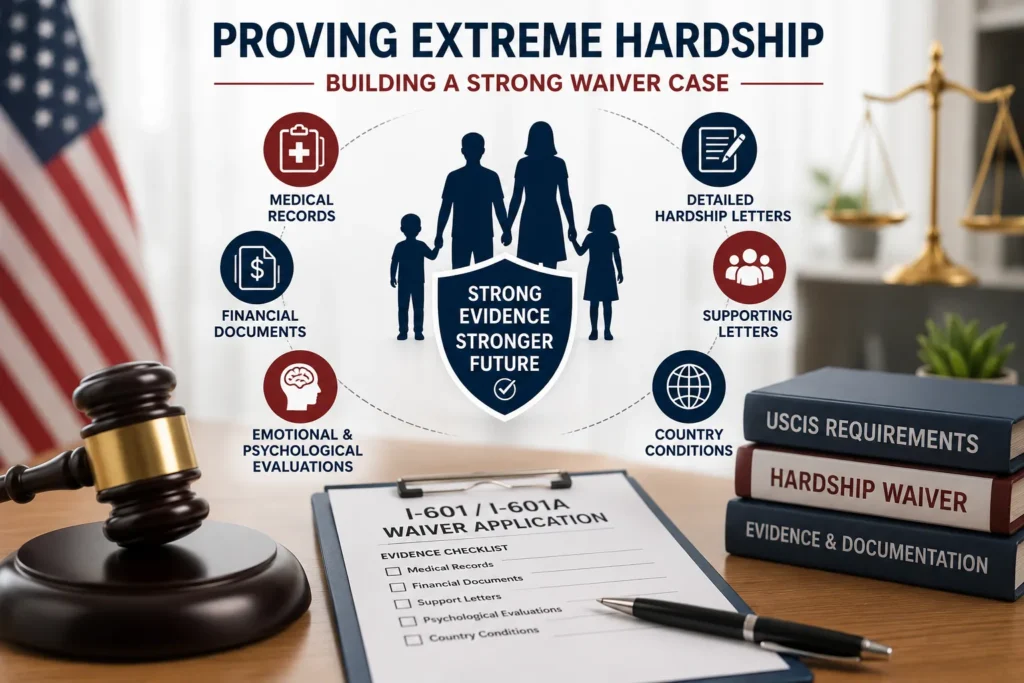
- Medical reports showing diagnosis and treatment history
- Hospital records showing ongoing care or emergencies
- Doctor notes explaining long-term conditions
- Financial records showing income, expenses, and dependency
- Tax returns and employment verification
- Psychological reports showing emotional or mental strain
In a hardship, evidence is what turns a story into something believable and convincing.
How the Case Is Actually Read as One Complete Picture
A hardship waiver immigration case is never judged in pieces. Everything is read together like one full life situation.
What Creates a Strong Overall Picture
- Medical issues combined with financial dependence
- Emotional stress backed by professional evaluation
- Real-world country conditions increasing difficulty
- Long-term consequences clearly explained, not short-term problems
A hardship waiver immigration application becomes powerful when everything feels connected and consistent, like one complete reality.
What Extreme Hardship Really Means in Real Life
An extreme hardship waiver is not about life being difficult or stressful. It is about life becoming significantly unstable or unmanageable.
Real Situations that Usually Show Extreme Hardship
- Serious illness requiring ongoing medical care
- Mental health conditions that worsen without support
- Total financial dependence on one person
- Unsafe or unstable conditions in the home country
- No access to proper healthcare or treatment systems
An extreme hardship waiver is about proving that normal life would not function properly anymore.
Why Legal Structure Makes a Big Difference
An immigration waiver attorney often helps organize everything so it is easy for USCIS to understand without confusion.
What Legal Guidance Actually Improves
- Turns scattered documents into a structured file
- Highlights the strongest hardship points clearly
- Removes weak or unnecessary information
- Builds a logical explanation of the situation
- Reduces errors that slow down or weaken the case
A hardship waiver is often decided not only on facts, but on how clearly those facts are presented.
How the Hardship Letter Should Actually Sound
A hardship letter for immigration is where the situation is explained in plain, human language. This is not a formal essay. It is a real-life explanation.
What a Strong Hardship Letter Actually Says
- What a normal day looks like at home right now
- How illness or dependency affects everyday life
- What financial pressure feels like month after month
- What emotional stress looks like in real situations
- What would actually change if separation happens
A letter of hardship for immigration becomes powerful when it feels real, specific, and lived-in instead of general.
Supporting Letters That Strengthen the Story
An extreme hardship waiver letter becomes stronger when other people confirm the same situation from their own perspective.
Who Adds Real Value in Support Letters
- Doctors explaining medical seriousness in detail
- Therapists describing emotional or psychological impact
- Employers confirming financial or work-related dependency
- Family members describing caregiving responsibilities
Each waiver support letter should sound like real observation, not emotional exaggeration.
How USCIS Actually Compares Everything
A USCIS extreme hardship waiver review is focused heavily on consistency. Officers are trained to catch mismatches.
What They Carefully Cross-Check
- Medical claims vs medical documents
- Financial claims vs actual income records
- Timeline consistency across all forms
- Whether hardship descriptions stay detailed and specific
- Whether everything points to the same conclusion
A hardship only becomes strong when every part of the file tells the same story without confusion.
Step-by-Step Way to Actually Prove Extreme Hardship
how to prove extreme hardship becomes much clearer when broken into a simple real-world process.
Practical step-by-step flow
- Clearly identify the qualifying family member
- Gather all medical and financial documents first
- Collect expert evaluations if needed
- Write a detailed explanation of daily life impact
- Organize everything in a clear, logical order
- Make sure everything matches and supports each other
A waiver is not built in one step. It is built piece by piece with consistency.
Common Reasons Cases Fail Even When Hardship Exists
A hardship waiver is often denied not because the situation is not serious, but because it is not shown clearly enough.
Common Reasons for Denial
- Missing strong documentation to support claims
- Inconsistent information across documents
- Vague explanations without real-life detail
- Financial dependency not clearly proven
- Disorganized or unclear case structure
A waiver must be easy to understand and fully supported.
Conclusion:
At the end of everything, a strong case is not about adding more words. It is about clearly showing real life in a way that USCIS can easily understand and believe.
Every document, every letter, and every explanation in a waiver should point toward one simple reality: life becomes significantly more difficult, unstable, and serious without relief.
A hardship waiver becomes successful when it is clear, consistent, and supported by strong real-world proof that tells one complete story.
Frequently Asked Questions
What is the most important thing in a hardship waiver case?
The most important part is strong, consistent proof that clearly shows how daily life would be seriously affected for a qualifying family member.
Why do strong hardship cases still get denied?
Because the evidence is often incomplete, unclear, or not properly connected to the claims being made.
Can emotional stress alone win a case?
No, emotional stress alone is usually not enough unless supported by medical or psychological documentation.
Why are financial records so important?
They show real dependency and prove that separation would create serious instability in basic living conditions.
What makes a hardship letter effective?
A strong letter explains real daily life situations with specific examples instead of general emotional statements.
How important are medical documents?
Very important, because they provide official proof of health conditions and ongoing treatment needs.
Do supporting letters really help?
Yes, they help confirm the situation from different trusted perspectives like doctors or employers.
What is the biggest mistake applicants make?
Not organizing evidence properly, which makes the case unclear or inconsistent.
How long does a hardship waiver usually take?
It varies, but many cases take several months depending on complexity and documentation quality.