When it comes to working in the United States as a top-level talent, the first thing most people check is the o1 visa approval rate. It tells you whether your dream of moving to the U.S. on the O-1 visa is likely to happen. And let’s be honest — knowing this number helps you plan your next steps without guessing.
Right now, the o1 visa approval rate is strong. Data from USCIS shows that most people who file well-prepared petitions get approved. That’s the good news. The tricky part? You need to know what counts as well-prepared if you want to make sure you’re part of that high approval group.
Why the o1 visa approval rate Matters
Think of the o1 visa approval rate as a success barometer. It’s the percentage of applications USCIS approves. In 2025 and 2026, it’s hovering around 94%, which is pretty high compared to other work visas. But don’t get fooled — this high number isn’t a free pass.
People applying for the O-1 visa are already top of their fields. That means the applicants themselves are strong. The o1 visa approval rate looks good because the pool is already high-quality. If your evidence is solid, you’re likely to get approval. If it’s incomplete or weak, you could be part of the small slice that gets denied.
Current O-1 Visa Approval Rate Trends
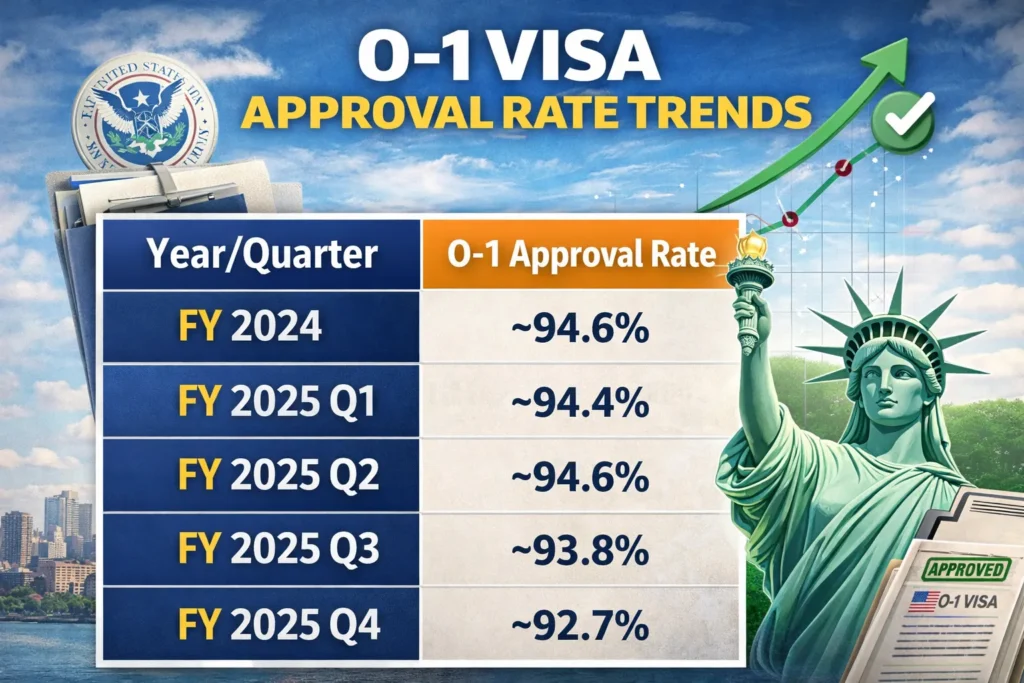
Here’s a simple snapshot of what’s been happening lately:
| Year/Quarter | o1 visa approval rate |
| FY 2024 | ~94.6% |
| FY 2025 Q1 | ~94.4% |
| FY 2025 Q2 | ~94.6% |
| FY 2025 Q3 | ~93.8% |
| FY 2025 Q4 | ~92.7% |
Notice how stable it is? That’s because USCIS looks for quality, not quantity. Only the well-documented, strong applications get approved, which is why the o1 visa approval rate stays high.
Why the Rate is So High
You might ask: “Why is the o1 visa approval rate so much higher than other work visas?”
- No cap or lottery: Unlike the H-1B, O-1 visas don’t have a yearly limit. File anytime. If your application is strong, it gets reviewed.
- Applicant quality: Only highly qualified people apply. If you’re extraordinary in your field, you belong here.
- Merit-based process: USCIS judges each case on achievements, publications, awards, contracts, and recognition — not luck.
So yes, the odds are good, but it’s still about quality documentation.
O‑1 Visa Categories
Understanding your category is crucial because it affects approval odds:
O‑1A – Business, Science, Education, Athletics
- For extraordinary ability in non-arts fields
- Evidence includes awards, publications, salary comparisons, and recognition
O‑1B – Arts & Entertainment
- Focuses on creative achievements: film, theater, music, and visual arts
- Evidence includes contracts, media coverage, and expert recommendation letters
Both categories require detailed evidence. This is where o1b visa requirements come into play for artists and performers.
Eligibility Criteria That Matter
Let’s break down o1 visa eligibility criteria in practical terms:
- Major awards or prizes in your field
- Memberships in organizations that require extraordinary achievement
- Published work about you or by you
- Original contributions that have impacted your field
- Serving as a judge of others’ work
- High salary compared to peers
If you tick most of these boxes, you’re setting yourself up for a strong o1 visa approval rate.
How to Apply for O‑1 Visa
Here’s a real-world, step-by-step guide:
- Find a U.S. employer or agent – Your petition must have a sponsor.
- Fill out Form I‑129 – USCIS uses this form to start your petition.
- Collect evidence – Media coverage, awards, letters of recommendation, contracts.
- Get an advisory opinion – Sometimes needed from experts in your field.
- Submit to USCIS – Don’t forget fees like the o1 visa application fee or optional premium processing.
- Wait for the decision – Standard processing can take months; premium processing is faster.
Doing these steps right dramatically improves the o1 visa approval rate for your application.
Costs to Expect
- O‑1 visa application fee: Paid by the employer
- Premium processing: Optional, speeds approval to ~15 days
- Legal fees: Hiring an immigration lawyer for o-1 visa can make a difference
- Document prep and travel: Minor but essential
Investing upfront often leads to higher approval odds, which is why many applicants consider legal guidance worth it.
Processing Times
- Standard: Several months depending on USCIS workload
- Premium: About 15 business days
Fast processing doesn’t improve approval chances, but incomplete or weak evidence will hurt. Remember, the o1 visa approval rate counts only complete, strong applications.
Role of a Lawyer
A lawyer isn’t required, but they can help you:
- Structure evidence effectively
- Avoid mistakes that trigger RFEs (Requests for Evidence)
- Ensure your petition tells a clear story of extraordinary ability
Many applicants see their o1 visa approval rate improve with legal support.
O‑1 to Green Card
Can an O‑1 lead to permanent residency? Yes, via routes like:
- EB‑1A Extraordinary Ability
- NIW (National Interest Waiver)
Timing depends on your case and the green card category. Planning early ensures smooth transition and maximizes the likelihood of approval.
Common Misconceptions
- O-1 is easy – Wrong. Approval rate is high because applicants are strong, not because standards are low.
- Premium processing guarantees approval – Nope. It only speeds decision.
- No lawyer means rejection – Possible, but mistakes are more likely without guidance.
Tips to Maximize Your Approval
- Prepare evidence early and thoroughly
- Highlight awards and media coverage
- Include letters from recognized experts
- Don’t underestimate formatting and organization
- Consider hiring an immigration lawyer for o-1 visa
Strong applications naturally boost your o1 visa approval rate.
Frequently Asked Questions
What is the current o1 visa approval rate?
The o1 visa approval rate is around 93–94% based on the latest USCIS data for 2025 and early 2026, reflecting strong approval odds for well-prepared petitions.
Does a high o1 visa approval rate guarantee acceptance?
No. Each application is judged individually. High approval rate only means well-prepared cases usually get approved.
How long does O‑1 visa processing take?
Standard processing takes months; premium processing is about 15 business days. Complete evidence improves your odds.
What are the main O‑1 visa eligibility criteria?
Awards, publications, original contributions, judging work, high salary, and expert recognition are key criteria.
Do I need an immigration lawyer for O‑1 success?
Not mandatory, but lawyers can organize evidence, avoid mistakes, and increase approval chances.
How much does an O‑1 visa cost?
Application fee, optional premium processing, legal fees, and documentation costs make up the total expenses.
Can an O‑1 visa lead to a green card?
Yes, through EB‑1A or NIW. Each path has separate requirements and timelines.
Does premium processing affect approval?
No. It only speeds up decision times; approval depends on evidence strength.
What’s the difference between O‑1A and O‑1B?
O‑1A is for business, science, athletics; O‑1B is for arts and entertainment. Evidence requirements differ.
What happens if my O‑1 is denied?
You can respond to an RFE or reapply with stronger evidence. Understanding reasons for denial improves future chances.