When people start comparing EB-1 and EB-2, they usually focus on processing time. They look at visa bulletins. They look at priority dates. But that is not where the decision really begins.
It begins with eb1 requirements.
Before anything else, the question becomes very direct. Does the profile truly meet the standard for EB-1? Not almost. Not close. Clearly.
The eb 1 visa is a first-preference employment-based green card. That means it sits at the top of the employment categories. It moves faster in many cases. It avoids labor certification in most situations. But it demands stronger proof.
The eb2 green card is different. It is more common. It supports advanced degree professionals and individuals with exceptional ability. It is solid and reliable, but it usually requires labor certification and often comes with longer waits.
So the real conversation is not about which is better. It is about which one actually fits the evidence.
What Is EB1 Visa?
Many ask what is eb1 visa and assume it is only for globally famous individuals. That is not accurate.
The eb 1 green card includes three main categories:
- EB-1A Extraordinary Ability
- EB-1B Outstanding Professors and Researchers
- EB-1C Multinational Managers and Executives
Each category has different documentation standards, but all depend on meeting strict eb1 requirements.
EB-1A allows self-petition. No employer is required. That is why so many professionals search how to get eb1 through this route.
EB-1B requires a permanent job offer from a university or research institution.
EB-1C applies to executives and managers transferring from an overseas company to a related U.S. entity.
In every case, approval depends on how clearly the evidence satisfies requirements for eb1 visa.
EB1A Criteria Explained
EB-1A is often the most discussed category. It gives flexibility, but the review is intense.
Under eb1a criteria, the applicant must show sustained national or international acclaim. That phrase carries weight. Sustained means ongoing recognition. Not one event. Not one promotion.
Examples of qualifying evidence include:
- Recognized national or international awards
- Published articles about the applicant
- Membership in associations requiring outstanding achievements
- Serving as a judge of others in the field
- Original contributions of major significance
- Authorship of scholarly publications
- High salary compared to others in the industry
Meeting three criteria is the technical requirement. But truly satisfying eb1 requirements means the entire case must show influence and distinction.
The officer reviewing the petition looks at the total picture. Do the achievements demonstrate leadership in the field? Do they reflect real impact?
That is how eb1 criteria for green card approval is evaluated.
Why EB1 Requirements Feel Strict
The reason eb1 requirements feel strict is simple. The category is meant for the top percentage of professionals.
A strong resume is not enough. Years of experience alone are not enough. Even a high salary by itself is not enough.
The petition must show:
- Recognition beyond one company
- Influence that extends beyond one project
- A reputation that reaches national or international level
This is where many applicants miscalculate. They assume qualification based on career length. But EB-1 focuses on distinction, not duration.
EB-2 in Straight Terms
The eb2 green card serves a different audience.
It supports:
- Professionals with advanced degrees
- Individuals with exceptional ability
- National Interest Waiver applicants
Most EB-2 cases require labor certification. That means an employer must prove that hiring the foreign professional will not displace a qualified U.S. worker.
Compared to strict eb1 requirements, EB-2 is more focused on academic credentials, professional expertise, and job necessity.
It is not weaker. It is simply different.
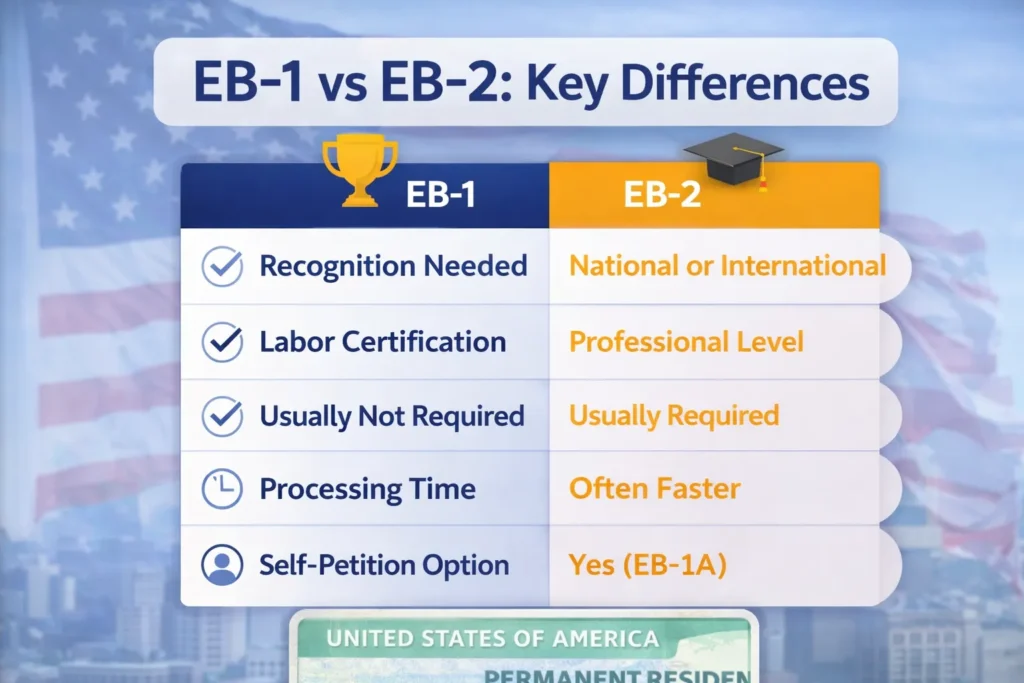
EB-1 vs EB-2 Comparison
| Category | EB-1 | EB-2 |
| Preference Level | First | Second |
| Recognition Needed | National or International | Professional Level |
| Labor Certification | Usually Not Required | Usually Required |
| Processing Time | Often Faster | Often Slower |
| Self-Petition Option | Yes EB-1A | Yes with NIW |
Meeting eb1 requirements provides faster priority in many cases. But the evidentiary burden is clearly higher.
EB 1 Green Card Qualifications
When reviewing eb 1 green card qualifications, it is important to focus on quality.
An award must carry weight.
A publication must show real impact.
A leadership role must demonstrate authority.
Every document submitted should clearly connect to requirements for eb1 visa.
Officers are trained to look for depth, not just quantity. A stack of documents without clear alignment to eb1 requirements does not strengthen a case.
How to Get EB1 Without Weaknesses
Many professionals search how to get eb1 quickly. The better question is how to get eb1 correctly.
Strong petitions usually:
- Align each piece of evidence with specific eb1 requirements
- Include detailed recommendation letters from independent experts
- Show measurable results such as citations, industry growth, or recognized contributions
- Demonstrate consistent recognition over time
The case must tell a clear story. Recognition. Impact. Leadership.
Without clear alignment to eb1 requirements, approval becomes uncertain.
When EB-1 Makes Sense
EB-1 may be the right choice when:
- There is documented national or international recognition
- Awards or media features show public distinction
- Leadership roles demonstrate authority in the field
- Evidence strongly satisfies eb1 requirements
For applicants from countries facing long backlogs, qualifying under EB-1 can significantly shorten the wait.
When EB-2 Is the Smarter Path
EB-2 may be the better option when:
- The strongest qualification is an advanced degree
- Employer sponsorship is available
- Recognition exists but does not reach extraordinary level
- The profile does not fully satisfy eb1 requirements
Choosing the category that matches the evidence avoids unnecessary denials and delays.
Conclusion:
The choice between EB-1 and EB-2 is not about preference. It is about fit.
If the profile clearly demonstrates extraordinary ability and meets eb1 requirements, EB-1 offers priority processing and fewer procedural hurdles.
If the evidence reflects strong professional qualifications but not sustained national acclaim, EB-2 remains a reliable and effective route.
The most important step is honest evaluation. Understanding eb1 requirements in practical terms helps determine the strongest path forward.
Frequently Asked Questions
What is the main advantage of eb 1 visa over eb2 green card?
Eb 1 visa holds first preference, speeding visa availability and cutting waits versus eb2 green card backlogs—ideal for urgent family or career moves.
Are eb1 requirements stricter than eb2 green card standards?
Yes, eb1 requirements demand sustained national/international acclaim, raising the bar higher than eb2 green card focus on degrees or skills.
Can someone self-petition under eb1 green card?
Yes, eb1 green card EB-1A allows self-petition without sponsors if meeting eb1a criteria—a freedom EB-2 rarely offers.
Does requirements for eb1 visa skip labor certification?
Requirements for eb1 visa usually eliminate labor certification, streamlining over EB-2’s mandatory PERM tests and delays.
How many eb1a criteria count for approval?
At least three eb1a criteria like awards or publications must hit, unless a major one-time prize covers it under eb1 requirements.
Is eb2 green card easier than meeting eb1 requirements?
Generally yes, eb2 green card leans on advanced degrees versus eb1 requirements’ acclaim proof, lowering the entry bar.
Why does eb 1 visa process faster?
Eb 1 visa first-preference status cuts visa bulletin waits compared to eb1 vs eb2 where EB-2 lags years behind.
What boosts chances under eb1 criteria for green card?
Strong eb1 criteria for green card evidence like awards, media, leadership roles, pubs, and contributions lifts approval odds high.
Can eb1 green card petitions shift to eb2 green card?
Yes, if eb1 green card denies, refile under eb2 green card if quals match—many use dual strategies wisely.
Should filings ignore eb1 requirements checks?
No, skipping eb1 requirements evaluation risks denial and fees, assess honestly first for best eb1 vs eb2 outcomes